Tuesday, November 7, 2017

Marketing Tool: Chatbots


80% of marketers are expected to be using chatbots by 2020. Personalized marketing is becoming an expectation for consumers, and chatbots are another tool to bring personalization to your audience. It is certainly fair to say that not every company will need a chatbot, and that some customers will not utilize or like the option of using a chatbot, but for ever-evolving times, it is important to understand this trend as it is, as it can be, and to fully acknowledge the pros and cons of using chatbots within a marketing strategy.
What is a Chatbot?
NBC defines a chatbot simply as: “simple artificial intelligence systems that you interact with via text. Those interactions can be straightforward, like asking a bot to give you a weather report, or more complex, like having one troubleshoot a problem with your internet service.”
How do Chatbots work?
A chatbot responds to a message just as a customer support employee would, but is available at all times. Siri, Google Assistant, and Alexa are all examples of widely used chatbots. Chatbots are programmed with specifically coded responses to questions or can be built with AI and can, therefore, expand their knowledge base with machine learning.  When your customer asks a question or interacts with your bot, the responses that it gives are modeled to act like a real human response. Sometimes, a question will be impossible for the bot to answer, either because it has no prior experience with that question or because it is phrased in a way too complicated for the bot to understand. If that is holding you back, there are ways to program your bot to have prompts that might be able to get the bot and your customers back on track.
Why use a Chatbot for marketing?
Chatbots do more than just answering questions, they can also effectively drive engagement, make sales and nurture leads. Because chatbots built to use AI can learn, they can also remember details and have a more personalized and human interaction with your customers, something that is important as “nine out of ten consumers say personalization has an impact on their buying decisions, “ says research from LeadsCon. The evolution of social media and technology has played into the need to utilize big data in order to provide a more targeted and engaging approach to customer support and marketing.  Check out Hubspot’s list of seven brands using chatbots and get inspired!
 Like this post? Read more at http://steverenner.com/blog-2/

Thursday, November 2, 2017

Marketing Tool: Generational Profiling


One size fits all marketing is a myth of epic proportions. Demographic profiling is one of the most important tools you can use when building a marketing campaign, and while demographics include language, location, age, and interests, generational profiling is another way to look at a broad overview of an age range. While not all members of a generational divide exhibit all of the traits that are common within the broader summary, embracing generational marketing is helpful for understanding prior influence and for predicting consumer behaviors. There are 5 major generations within our society right now, and each brings new experiences to the table. These profiles will help marketers understand these generational differences.
The Silent Generation (Traditionalists): Born 1945 and before
Members of this generation were children during World War II and were named the “Silent Generation” by TIME Magazine, because of the nature of the political and social world they had been born into. Because of the anti-communist beliefs, speaking freely was dangerous, and attempts to keep up a “clean” public image became much more measured. This generation was more financially cautious than their parents, especially after seeing the long-lasting effects of both the war and the Great Depression as young children. Statistically, this has always been a smaller generation, and as they age, numbers continue to dwindle.
Baby Boomers: Born 1946-1964
The Baby Boomers were free-thinking and spirited, generally moving away from traditional values held by their parents. Defining events for this generation included the civil rights movement, the moon landing, the rise of television and rock ‘n’ roll, as well as the assassinations of Martin Luther King Jr. and President John F. Kennedy. This was the first generation of children and teenagers to have an influential amount of spending power, and the generally low saving, high consumption lifestyle introduced a booming “youth-focused” culture, in fashion, music, and vehicles.
Generation X: Born 1965 to 1979
The anti-establishment Gen X-ers were rebellious, thinking in anti-consumerist ways and many were just beginning to gain traction in their careers when the great recession struck. Important events for Gen X were the introduction of personal computers, the AIDS epidemic, and the Watergate scandal. Gen X is called “America’s neglected middle child” by Pew, stuck between the loud, overspending Boomer, and the student-loan burdened Millennial.
Millennials (Gen Y): Born 1980 to 1995
Perhaps the most talked about generation right now, for better or worse,  Gen Y, or Millennials have been discussed extensively. Millennials are often called entitled and narcissistic and are known for being tech-savvy, environmentally and socially conscious, and creative. Millennials lived through 9/11, internet and social media growth, the fall of the Berlin Wall, and a revitalized pop culture. The weight of student-loans weighs heavily on this generation, with the entire generation carrying about $1 trillion in student debt, and 48% of employed college graduates working jobs they are overqualified for, according to Inc.
Gen Z: Born 1996 and beyond
The youngest generation currently, Gen Z or the iGeneration comes across a lot like millennials, but more intense. This generation has never been without the internet, and the understanding of technology is further along than before. Gen Z is the most diverse generation, and is also one of the largest generations, with a population of over 23 million. Gen Z is critical of big government, values privacy, and has a lower amount of optimism about the future than their millennial counterparts. The war on terror, the advent of social media and the great recession will all be defining factors for these young people.
Demographics are a key part of building a target market for any new marketing strategy, and part of that has become understanding generational differences to better understand influence and consumer trust. The relationship between marketing and generational profiles is not a new one, but it is something that changes rapidly, and thus needs to be continually analyzed.
 Like this post? Read more at http://steverenner.com/blog-2/

Monday, October 30, 2017

More Than The CEO: Hidden Talents of Business Leaders


Recently, a video surfaced of Alibaba CEO Jack Ma performing for employees at a conference dressed as Michael Jackson. This is not the first time that he has done something like this either. In 2014 he sang songs from “Lion King” for his employees, and now he’s at it again, less than a month after his Jackson performance, surprising everyone once again with his singing performance at a music festival hosted by Alibaba. Check out his performance here.
Jack Ma isn’t the only business leader with hidden talents though, these big names in the business world have hobbies and talents that may surprise you!
Jack Dorsey: Botanical Illustration
After launching a failed business in the early 2000s, Twitter co-founder Dorsey took a break to study Botanical Illustration (scientific drawings of plant anatomy) In an interview with the New Yorker he said: “I really like any colony-based structure, where you have a strong dependence on a network.”
Warren Buffett: Ukulele
When he isn’t making headlines as the CEO of Berkshire Hathaway, Buffett enjoys spending time with his family and practicing his hidden talent: playing the ukulele. He’s been featured on NPR and has even toured with his son. You can read the story of his journey to ukulele success here.
Sergey Brin: Trapeze
Brin has lived an exciting life as a co-founder of Google, and some of that excitement is found in high adrenaline exercises such as gymnastics, skiing, skydiving, and trapeze. Check out this video to see him skydive to promote Google Glass in 2013.
Mark Zuckerberg: Mandarin, sustainable living and more
The Facebook mogul has taken on a new challenge every year, setting personal goals like running 365 miles in a year, visiting all 50 states, learning Mandarin, and getting into sustainable living by only eating meat that he has killed himself. This yearly goal setting is great for him, and you might want to consider it as well to unlock these benefits.
William Clay Ford Jr.: Taekwondo
The great-grandson of Henry Ford and Executive Chairman at Ford was called the “Buddha of Detroit” by the New York Times in 2000. His zen approach to life and focus on environmentally friendly living makes him a mindful leader. Ford can probably accredit this to his study of Taekwondo, a Korean self-defense practice in which he has received his black belt.
 Like this post? Read more at http://steverenner.com/blog-2/

Tuesday, October 24, 2017

11 Herbs & Spices: Brands That Embrace Their Personalities on Twitter


Earlier this week, Twitter user Edge (@edgette22) noticed something funny about KFC’s Twitter page that made headlines for the brand.


The quiet execution of this comical marketing strategy isn’t the first time that a brand has used Twitter to subvert traditional marketing efforts for a more playful strategy. Think back to Wendy’s always sassy Twitter responses, like this one:

Fast food companies aren’t the only brands establishing themselves as Twitter masters, check out these examples of brands showing off their personality on social media!
Netflix (@netflix)
The streaming giant knows what it’s target audience is thinking.

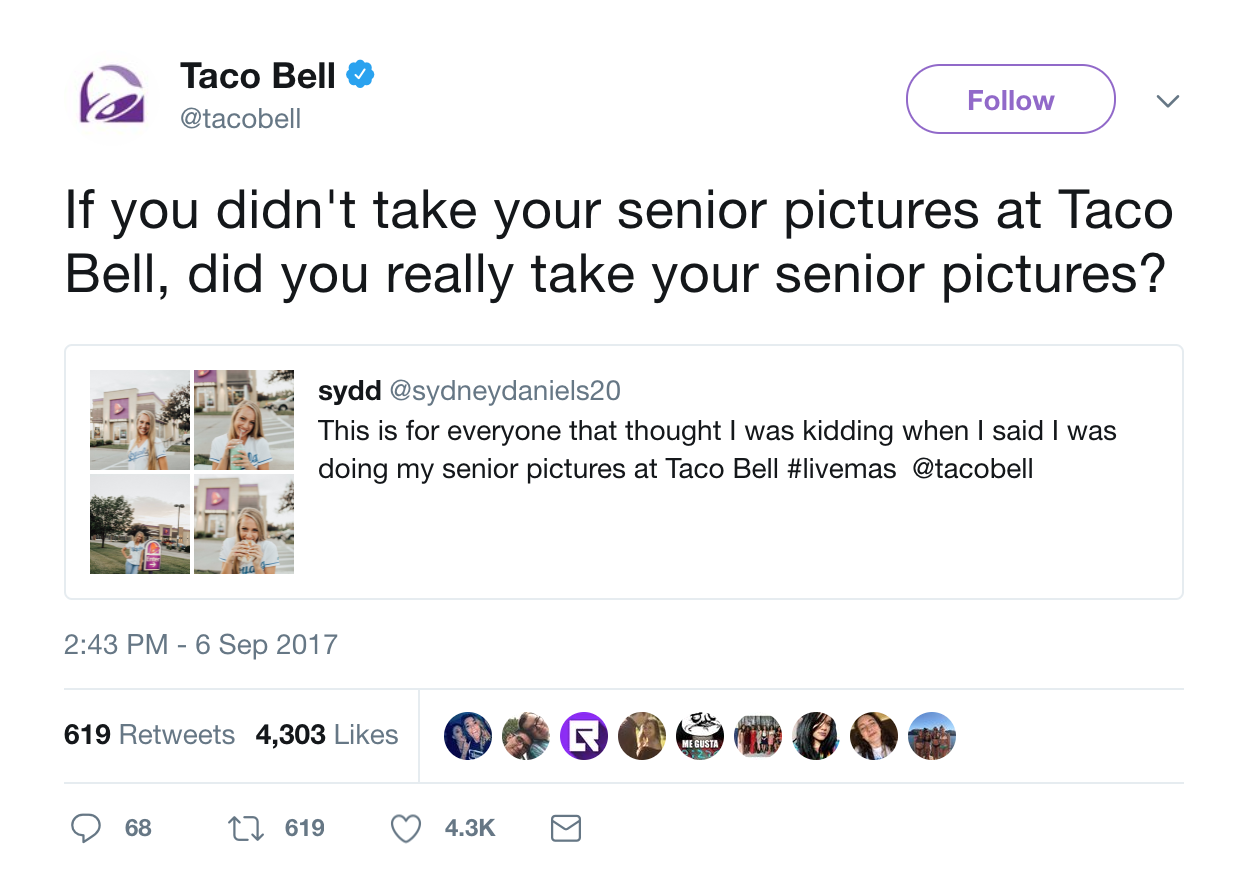
Taco Bell (@tacobell)
Taking senior portraits at Taco Bell has been a trend this year, and the brand took notice.

Chipotle (@ChipotleTweets)
Promoting their online ordering capabilities while disrupting everyone’s Tinder game.

Totino’s Pizza Rolls (@totinos)
Starting with the name of the account (Pete Zaroll) and the anthropomorphic pizza roll that personifies the account, this General Mills brand really brings the sass, especially when it comes to brand recognition.

Hamburger Helper (@helper)
Another General Mill’s brand, Hamburger Helper’s Twitter account has been in the news lately due to its quick-witted responses like this one:

DiGiorno Pizza (@DiGiornoPizza)
With a tagline like “It’s not delivery. It’s DiGiorno”, would you expect anything less than sassy tweets?

Old Spice (@OldSpice)
Never one to shy away from unconventional marketing and commercials, Old Spice continues that trend with their Twitter feed.

Innocent Drinks (@innocent)
This healthy smoothie/juice company based out of the UK has a Twitter feed filled with gems like this one below. What more could you ask for from a brand’s social media?

Moosejaw Mountaineering (@MoosejawMadness)
Self-described as “the most fun outdoor retailer on the planet”, Moosejaw’s Twitter is filled with funny quips like this one:

Have some more examples? Share them in the comments section below.

 Like this post? Read more at http://steverenner.com/blog-2/

Friday, October 20, 2017

Black Friday 2017 Predictions


With only a few weeks until Thanksgiving on November 23rd, savvy shoppers are ramping up to this year’s Black Friday deals and sales. Black Friday and Cyber Monday have become some of the biggest shopping days of the year, and sales keep getting bigger and bigger. In the past, sales have started on Thanksgiving and gone into Black Friday proper and the weekend and Monday following the holiday (Cyber Monday), but in recent years, retailers have begun their sales earlier and earlier, sometimes having promotions all month long. Look for these trends this November!
Spending
According to predictions by the National Retail Federation, Holiday sales (retail sales between November and December) will grow by up to 4% from last year, up to a $682 billion dollar amount. PwC’s holiday outlook data suggests that the average holiday spend for 83% of US consumers is expected to be $1,189.
Top Stores
DealNews.com suggests keeping an eye on sales at Kohl’s (where your savings will largely be in Kohl’s Cash), Best Buy, Target, Wal-Mart and Amazon this year, however, the best places to make your purchases will depend on what your items of interest are and will also be largely based upon price point. Forbes has a list of where to look for tablets and laptops this year, which can be found here.  If you are interested in Apple Products, online retailers will likely have better discounts on Apple products than the Apple Store itself.  Last year, Apple’s Black Friday deal included a gift card with the purchase of older product models at an undiscounted rate, and that is expected to continue this year, hinging on whether Apple even decides to participate in Black Friday/Cyber Monday.
Top Deals
Video game bundles for the PS4 Pro and Xbox One X are rumored to be heavily discounted this year, as well as many smartphones including the newest iPhones (8, 8 Plus and X), the Samsung Galaxy S8 and Note 8 and the Google Pixel 2. Discounted prices for 4K TVs and 4K media players are also expected.
 Like this post? Read more at http://steverenner.com/blog-2/

Tuesday, October 17, 2017

Is Digital Marketing Destroying Marketing As A Whole?


Looking into the future of marketing many times forces us to look into the past. What has worked? What hasn’t? Is there something that was executed poorly that could be re-integrated into a more current strategy? But looking at the past faces of marketing might make marketers of today nervous, and for good reason. TechCrunch released an article on how the use of Google Analytics has changed marketing, and in their opinion, changed it for the worse.
Simply stated, Google Analytics has allowed marketers to focus solely on digital methods, sometimes getting poorer results than could be expected if strategies and channels were paid more attention to in the overall view of what marketing can be. Marketing has shifted completely from the advertising empire that was so renowned in the days of Madison Avenue. Gone are the days of a basic strategy and here are the days of separate and not usually equal use of marketing channels.  
This isn’t to say that digital marketing isn’t important. In fact, with the amount of people who own computers, cell phones and other devices, digital marketing (which includes social media, native advertising, influencer marketing and any mobile marketing or apps) and mobile marketing have rightfully become some of the top ways to generate more customers and revenue as well as increase public knowledge of brands.
The deceiving part of this is that at least in the United States, people are spending more and more time watching TV, with the daily time devoted to television almost equal with the amount of time spent working (According to this article from the Washington Post). But television marketing isn’t something that you hear many marketers discuss on a day to day basis, especially in the world of startups, where money is tight and marketing efforts need to do more for less.
The reasoning behind this may be that marketers of today don’t fully comprehend differences of what content, channel, and strategy are. Just like television is a channel for advertising, channels in digital marketing can be search results, Facebook, Twitter, Instagram, Snapchat a blog and any other platform you may think of. Content is what you post on these channels: videos, blogs, images, testimonials, the list goes on and on. And the backbone of it all: strategy. Strategy can be advertising, promotion, SEO, publicity, personal selling, direct marketing, essentially asking what the purpose of content on a specific channel is.
For marketing to work as it is supposed to, marketers need to go back to basics and relearn how they connect with their audience and for what purpose. Google Analytics does not deliver you the information you need to decide if the return on investment (ROI) you get from social media is from any specific strategy, which negates any ability to change or improve a strategy if all you see is that the ROI is there and often comes across as “good enough”.
Google Analytics is without a doubt useful and important to continue using, but the key to overall marketing success is remembering that it A) does not track all marketing efforts (only online campaigns) and B) does not always give you the details you need to make the strongest decisions for your overall marketing quality. Branch out and learn about other ways you can track your ROI and success, try new content and channels. You never know what strategies might work for you.

 Like this post? Read more at http://steverenner.com/blog-2/

Wednesday, October 11, 2017

Tech Radar: Google Pixel 2

Photo by Maurizio Pesce via Flickr

On October 4th, Google’s tech event revealed a number of changes and product releases, including announcing the newest iteration of the highly rated Google Pixel cell phone: the Google Pixel 2. This is what you need to know before you buy!
Features:
The original Pixel heralded an extremely high-quality camera and the Pixel 2 is no different. The photo quality is outstanding, even in low light. As an added bonus, you are able to store the photos and videos you take for free with unlimited online storage. The water-resistant phone is equipped with fast charging technology, similar to its predecessor and comes with an improved version of Google Assistant. In a drastic departure from the original Pixel, the 3.5 mm headphone jack has been removed, an interesting change after the introduction of the original Pixel that shaded Apple for their headphone jack removal on the iPhone 7.
The Pixel 2 is available in four colorways and in two sizes.
Specs:
The Pixel 2 is loaded with high tech updates, including the 835 Qualcomm Snapdragon processor, a dual focus camera, pOLED screen, updated security functions, and high-quality stereo speakers. There is a 5-inch screen on the Pixel 2 and a 6-inch screen on the Pixel 2 XL. Both sizes come with 64 GB and 128 GB storage options.
Pricing:
The Pixel 2 starts at $649, and the Pixel 2 XL starts at $849. Both models went on sale October 4th.
Read more about the Pixel 2 and the other products announced at Google’s October 4th event here.
 Like this post? Read more at http://steverenner.com/blog-2/