Showing posts with label rebrand. Show all posts

Thursday, November 30, 2017

5 Rebranding Fails


Rebranding any company can be tricky business, and there is no guarantee you will always get it right. These five companies are proof of that. Check out some of the most hated, most ridiculously expensive, and most cringe-worthy rebranded and redesigned looks in recent branding history.
Tropicana Orange Juice- Underestimating brand loyalists

In 2009, Tropicana decided to change their look by offering what they thought was a sleek and sophisticated design ready for the modern market. After two months of the redesigned packaging being on shelves, sales had dropped 20%, meaning a loss of 30 million dollars. The design and campaign and the loss in sales cost the company more than 50 million dollars.  But why did it fail? Customers reported a deep emotional bond with the original packaging, and when the rebranding occurred, they found what they called the “ugly” design to be too close to generic brands or store brands and also worried that the product itself had changed, not just to look of the packaging. Read more about the Tropicana branding failure here.
Pepsi- $1 million for a complicated process
Pepsi Logo

Pepsi Logo (2009)

The logo itself released in 2009 wasn’t unsightly in the least, but the cost to end up with the final product seemed unjustifiable, especially if you look at the overly complicated design document for the project which talks about “Pepsi’s gravitational pull”, balanced energy fields and “numerical harmony”.  Pepsi’s logo has been changed about once every ten years, but their competitor Coca-Cola has hardly ever changed their logo.
Gap- the Gap in the gradient
Gap Logo

Gap Logo (failed redesign, 2010)

During the holiday season of 2010, a silent and disastrous event took place. Gap had launched a new, crowd-sourced logo (estimated to cost about $100 million)  to replace the original 20-plus year old one. The logo (bold black font to spell Gap with a blue gradient square) began to generate negative buzz in the design community and after only six days, Gap was back to using the tried and true original logo.
MasterCard- the color blob
Mastercard Logo (1996)

Mastercard Logo (2006)

MasterCard’s logo is one that is instantly recognizable, from the overlapping circles to their brand’s color scheme. There was, however, a time when the logo was not so attractive. In 2006, the two circles were marred with an off-center and out of focus third circle in between, with the name of the corporation “Mastercard Worldwide” (formerly Mastercard International) underneath it. From a design perspective, this short-lived logo looked rushed and sloppy, a far cry from the current iteration.  
BP- from green to black
BP logo prior to 2000 redesign
BP logo (2000)

In 2000, BP’s mission was to project their appearance of “green growth” which led the petroleum company to set forth and redesign their logo to reflect that. The green Helios sunburst which became the new face of the company had a rumored rollout cost of $211,000,000. When the logo was first released it was not well responded to, and it took time for the uproar and negative reviews to die down. Things stayed quiet for a while, but in 2010, the “green” company was responsible for what is considered the largest marine oil spill in industry history: Deepwater Horizon. For a company trying to promote themselves as “green” in an inherently not industry, this incident only furthered the outrage.

 Like this post? Read more at http://steverenner.com/blog-2/

Tuesday, October 24, 2017

11 Herbs & Spices: Brands That Embrace Their Personalities on Twitter


Earlier this week, Twitter user Edge (@edgette22) noticed something funny about KFC’s Twitter page that made headlines for the brand.


The quiet execution of this comical marketing strategy isn’t the first time that a brand has used Twitter to subvert traditional marketing efforts for a more playful strategy. Think back to Wendy’s always sassy Twitter responses, like this one:

Fast food companies aren’t the only brands establishing themselves as Twitter masters, check out these examples of brands showing off their personality on social media!
Netflix (@netflix)
The streaming giant knows what it’s target audience is thinking.

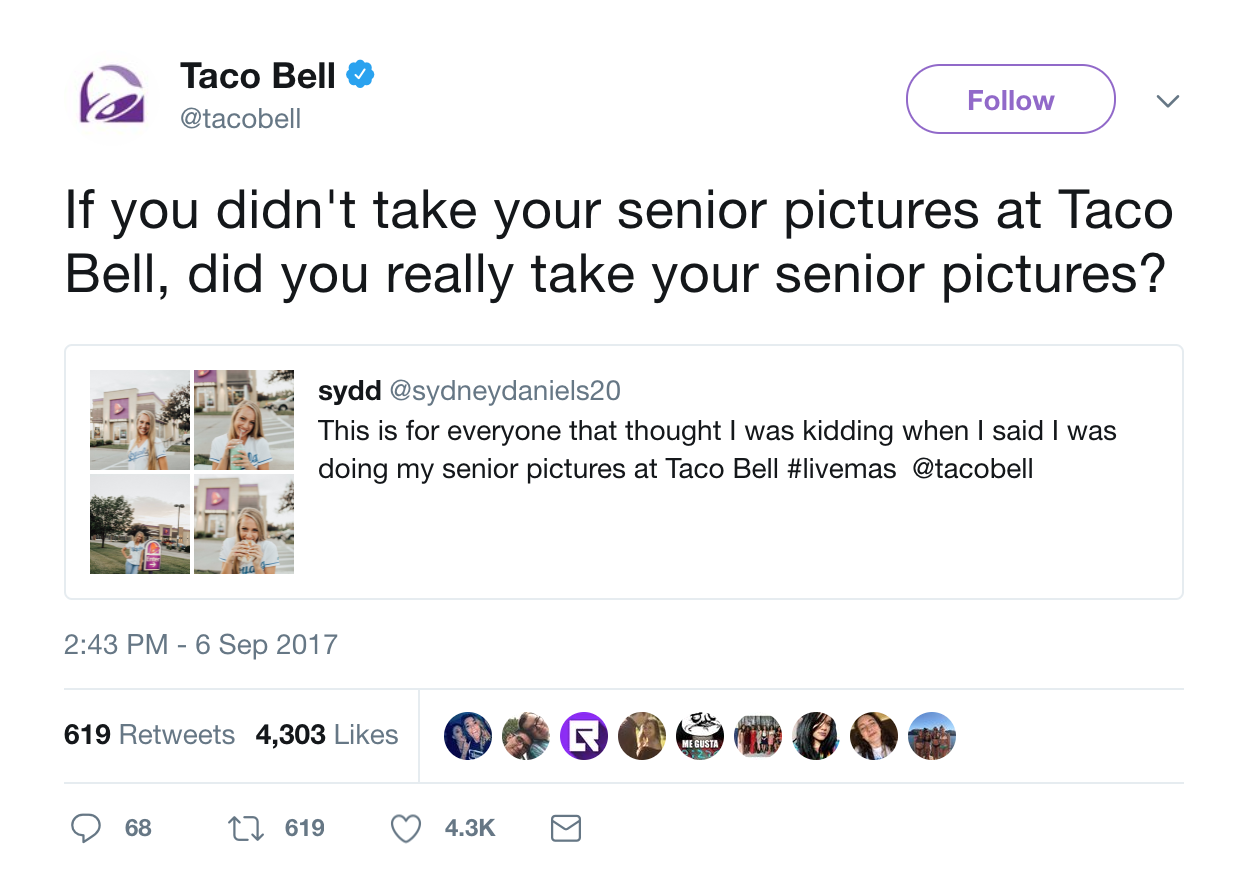
Taco Bell (@tacobell)
Taking senior portraits at Taco Bell has been a trend this year, and the brand took notice.

Chipotle (@ChipotleTweets)
Promoting their online ordering capabilities while disrupting everyone’s Tinder game.

Totino’s Pizza Rolls (@totinos)
Starting with the name of the account (Pete Zaroll) and the anthropomorphic pizza roll that personifies the account, this General Mills brand really brings the sass, especially when it comes to brand recognition.

Hamburger Helper (@helper)
Another General Mill’s brand, Hamburger Helper’s Twitter account has been in the news lately due to its quick-witted responses like this one:

DiGiorno Pizza (@DiGiornoPizza)
With a tagline like “It’s not delivery. It’s DiGiorno”, would you expect anything less than sassy tweets?

Old Spice (@OldSpice)
Never one to shy away from unconventional marketing and commercials, Old Spice continues that trend with their Twitter feed.

Innocent Drinks (@innocent)
This healthy smoothie/juice company based out of the UK has a Twitter feed filled with gems like this one below. What more could you ask for from a brand’s social media?

Moosejaw Mountaineering (@MoosejawMadness)
Self-described as “the most fun outdoor retailer on the planet”, Moosejaw’s Twitter is filled with funny quips like this one:

Have some more examples? Share them in the comments section below.

 Like this post? Read more at http://steverenner.com/blog-2/

Tuesday, June 6, 2017

Building a Personal Brand


A personal brand is similar to a brand for your business, but building a personal brand has different benefits, strategies and reasoning. If you are looking to build your personal brand, these tips can help you to remain authentic to the image you are creating for yourself. A personal brand doesn’t even need to be something you are selling, it is simply a way to state who you are and remain faithful to that vision of yourself.
But first, why do you need a personal brand? This is a misleading question, simply because everyone already has a personal brand whether or not they have worked to cultivate it. Don’t believe it? Think of all the interactions you have had in your life and the impressions you have made. Take it a step further and Google yourself and your hometown. If you are on social media, many times your reputation will precede you. So, the important part of having a personal brand is the ability to showcase the most positive aspects of yourself and separates you from the rest of the crowd. This is how you can create a personal brand that will not only define the best version of you, but can also help to further your goals.
Identify Your Authentic Self
Don’t build a brand around the you that you want to be, as this can be too difficult to maintain. Instead, reflect your true self, and stay consistent with that image. Craft the wording in your social media and blog posts the way that you speak in videos and in person. Don’t change your core values to fit a standard you can’t consistently live up to. No one is perfect all the time. Be the real you and people will respect you for it, giving you even more influence.
Social Media
Social media is key to presenting an authentic version of yourself. Post what you like with your real voice powering the posts. Don’t post your meal on Instagram if you don’t feel a calling to do that, all that means is that it isn’t authentic to you. Brand authenticity is also important, so if you are running a blog about interior design you wouldn’t post a phone review. Consistency is key for building a successful brand.  
Networking
Meet others through networking events and get your name out into the world, find others to collaborate with and even make friends. This is a great way to present yourself as the brand you are working to craft in a professional way. Meetup.com is a good resource for finding networking events in your area.
Develop Value For Followers
Find your niche market and the value you specifically bring to it. If you are a makeup artist, you need to set yourself apart from the thousands of other makeup artists, whether that is by doing costume makeup, working with a specific product or specializing in one technique. By doing this, you cement yourself as an expert in this area, meaning that your name becomes synonymous with whatever it is you are doing, meaning more recognition as your brand gets more established.
Do What Feels Right for Your Brand
You can read thousands of blogs about how to craft the most successful personal brand, but that advice will not always be what works for you. If you are seeing return and not following every piece of advice that you see, or only following that which is useful for your situation then you are doing fine. You have full control of what your personal image is, so do the things that work to continue making your brand work.
 Like this post? Read more at http://steverenner.com/blog-2/


Tuesday, February 14, 2017

Steve Renner Talks Rebranding


Join Steve Renner as he discusses trends in marketing, technology and  business. This episode focuses on creating an effective brand through rebranding. Watch it below.


Steve Renner has been involved in Internet Marketing since the ‘first days’ of the Internet. Technology has changed a great deal since he started, but Steve continues to be at the technological forefront. He continues to bring products to help your business.

Apart from being an Internet marketing pioneer, Steve is also passionate about writing. He has contributed chapters to books by Brian Tracy, Jack Canfield and Richard Branson, so that he can share his insights into a successful life with you.


Like this post? Read more at http://steverenner.com/blog-2/


Tuesday, January 31, 2017

Things To Consider Before Rebranding


Don’t let shiny new logos distract you, rebranding can be a long and tedious journey. Rebranding is a process that recreates a business or organization’s identity from the inside out. It changes who you are to the world, so foresight and creativity have to go hand in hand. If your business or organization is thinking of or in the process of rebranding, here are some things to consider in no particular order.
Why Rebrand
There is no one size fits all rebranding. There are many reasons that organizations decide to rebrand, and those diverse reasons will dictate approach. Whether you are changing customer landscape, adding competitive edge, or cleaning up bad PR, it’s important to choose a plan of action that fits the reasoning. Get specific, make tangible plans and consider recruiting the help of a branding agency if need be.
What Is Success  
No one can get to where they need to be if they don’t have a clear definition of what and where that is. Success can have many different faces and facets. What is your organizations looking to achieve with rebranding? What are you willing to invest in terms of time, money and resources? What kind of return is the organization expecting from that investment? Once you have a clear and defined end goal, try to set a few benchmarks along the way ensuring you stay on track.
Present
Do an inventory and find out where the current brand stands. There’s no need to throw the baby out with the bathwater! Find out what is working and how to extract the value and protect it. Make explicit lists of what’s staying, what’s going, as well as what’s changing and how. This will give the rebranding team clarity and guide strategy.
Strategy
Communication is the key of execution, great execution will excite your base and entice your new audience. Execution of new branding is a total balancing act. While promoting the shiny new brand it’s important to take time to re-educate the existing customer base about the new changes and ensure they aren’t being left behind, while still garnering excitement from those who are new to the brand.
Like this post? Read more at http://steverenner.com/blog-2/