Showing posts with label Digital Marketing Trends. Show all posts

Monday, April 22, 2019

Tips to Create Shareable Content in 2019


Social media likes are a type of currency. But shares are where it’s at for growing your reach. A share will organically generate more views to your post. If you get one share on a blog or social media post, it can domino into another, then another, and another, building brand awareness, expanding your reach and data footprint. All you have to do is create content worth sharing. How do you do that? Follow along.
Quality Over Quantity – But Pay Attention to Quantity.
The Internet is chock-full of tips on creating shareable content— however, you may find that much of the advice made widely available is so generalized and ambiguous it may not be helpful at all. Phrases that you may find are things like, “Posting good content guarantees shares and increased traffic!” That’s not false by any means, but what exactly is the proverbial “good content”?
Quality is a no-brainer. Audiences will share content that is relevant and of value to themselves and their social media network. Relevant content is built on audience research. Who is your audience? Who is your audience’s audience? Who do they follow? What do they already share? With the answers to these questions, you can start generating potentially shareable content.
By posting your content online, you’re just starting a conversation with your audience. The key now is to establish a back-and-forth rapport (you post, your audiences share; they post, you share). Ultimately, when done right, this can establish an ongoing relationship.
Titles- Not Just For Books
There’s a lot of content on the Internet. Millions of blog posts are published every day. Social media users and platforms are constantly increasing, and all of these writers and social media users are generating, liking, and sharing content, all the time. You need your content to stand out in the crowd. A good first step is to give them a title that really hooks your audience.
Start small. Use your general topic to come up with a few specific working titles, which are whittled-down, enough to guide the direction of your post.
Now make that working title, fun and unique. Test bold and strong language against more conservative and direct titles, and find the balance between the two. If you need to workshop your titles don’t be afraid to ask for second opinions. Having another opinion is valuable; don’t waste the chances you have to get one.
There are rules, guidelines, and tips galore on the web for you to find. Choose what works for you and your audience.
Note: People love to scan titles especially on Twitter, using an RSS reader or otherwise. Get them to take the next step and click-through with a title that is short, succinct, and interesting.
What Kind of Content Matters Too
Simple content is hands above more shareable. The way blogs and social media posts work is by making use of tidbits and clickbait. People generally respond very well to short form copy like lists and listicles. Your audience is busy, and the quickest way they can go through interesting and valuable content, the happier they will be.
SEO FTW
Although clarity and (sometimes) brevity is key to sharable content, making sure your SEO is well thought out can be a huge plus for reaching those that are maybe not already part of your consistent audience. Keep in mind that trying to over optimize your titles or posts can often sound awkward, and make your words sound like they were automatically generated for optimization by an SEO tool.
In order to effectively use keywords in your blog or social media titles and posts, research your potential customer base: What are they searching for? What problems do they face? How can you either help them directly or help inform them of other solutions? With the answers to these questions, you can choose and use relevant keywords, which will help you to become more searchable.
Note: Keyword rank isn’t the biggest barometer for success in search anymore. See this previous post to learn why.
A Picture Says A Thousand Words… (Infographics, Videos, and Other Visuals Can Too)
It takes more than a snappy title and intro for a post to be truly shareable. Images, infographics, videos, charts, tables, and block quotes can dress up and increase the influence of an otherwise text-forward post. Any visual you choose must, like everything else, be accurate and relevant. Use visuals to promote content that offers solutions to your audiences’ problems, in useful and creative ways, so that you can garner shares and valuable comments.
Tip: Don’t forget to read comments on your content. They’re an excellent measure of post success.

Tuesday, August 14, 2018

Engagement Insights For Facebook Business Pages


In January, Facebook announced a change to its news feed algorithm that would prioritize personal content from family and friends over content from Pages, which caused panic for many businesses that rely on Page engagement for growing their brand and generating new leads. Buffer and BuzzSumo collaborated to analyze 43 million posts from the pages of the top 20,000 brands on Facebook, and this is what they found.
Page Engagement has dropped
It was broadly assumed that with the algorithmic changes there would be a decrease in brand engagement, but the amount of decline was up in the air. Now, after the changes, Buffer’s study discovered that engagement on brand pages has dropped over 50%, with post engagement falling nearly two-thirds from where it had been previously.
Page types hit with a drop in engagement
The study ranked ten-page categories to determine which type of page was hit with the largest engagement drop. Artist Pages were found to be affected the most with a 70.6% drop in engagement, and retail Pages were affected the least with less than a 50% drop.
Pictures not video content
There has been a huge push for video content, and Facebook is leading the charge on that with a focus on live video and original content streaming (both live and pre-recorded) through Facebook (Watch, IGTV); but this study found that the content that received the highest engagement was not video, but images. Despite that, interaction for all content types is down, with an over 63% drop in average per post engagement.
Post volume to combat decreased engagement
In the last year, the analyzed Pages have posted more content with posts per quarter up to 8.1 million from 6.5 million, which is a 24% increase. Quantity vs quality is still a hot debate, but there is a sweet spot for getting noticed.
How many times to post in a day
In that same vein, there are findings related to how frequently pages post and the following per post engagement as well as overall page engagement. The study found that Pages posting less than one time a day have the highest per-post engagement, but also have the lowest overall engagement. The optimal number of posts for longterm overall Page engagement was found to be right around 5 posts per day. This is not an end all be all strategy, but might be a good thing to try if you are looking to boost long-term metrics.
Learn more about what the analysis uncovered and read the full study here.
Like this post? Read more at http://steverenner.com/blog-2/

Monday, June 11, 2018

Marketing Tips: Keyword Research and Planning For Improved SEO


If you’re looking to improve your SEO and haven’t done much research into keyword planning, you might not realize how important it really is. Knowing how to use and find the right keywords is arguably the most important skill a marketer can hone when it comes to search effectiveness. The start of effective SEO comes from a well-built keyword map or keyword plan.
What is keyword mapping?
“Keyword mapping is the process of assigning or mapping keywords to specific pages on a website based on keyword research. Based on your mapping process you are able to then make specific on-page SEO recommendations to help make the page more relevant to the mapped keywords.” Says Adam Bate of SEO Brothers.
How to start keyword planning
Step One: Research
Put together a list of all of the words you might want your business to appear when someone searches that word. It would be nearly impossible to achieve getting your business to rank on the first page of search results for every word you choose but here you can shoot for the stars.
Tools like Moz, SEMrush and the Google keyword planner can help you expand your list and include faceted keywords you may not have initially thought of.
Step Two: Filter
Work on removing any duplicated words, as well as any that you know for a fact you won’t rank for (taking out branded terms from competitors is usually a good starting point).
Now set your keywords into sets: Priority, Secondary, and Other Terms.
  1. Priority terms: Should be keywords you want to appear for right away. They need to imply that you have the answer to a question or the ability to fulfill a need; be a high volume keyword that is worth the investment, and need to be related to current and upcoming (near-future) business.
  2. Secondary terms: These will come into play later on, once priority keywords are locked into optimized pages that are query-responsive. These should be keywords that relate to your site, have a decent volume and imply questions you don’t have the expertise to answer.
  3. Other terms: You’ll ignore these for now, and note why you may or may not want to re-evaluate these keywords later on
Step Three: Map keywords to pages
The first thing to do when mapping is to scrape Google for your keywords and current rank. You don’t have to do this, but generally, it is useful to be able to keep things simple, rather than to manually map each page, regardless of how Google feels about scraping and rank tracking (the general consensus is not incredibly positive). Now you need to ensure that the content on the page that the clickthrough directs to actually answers what is being searched for. Sometimes your map will work perfectly, and other times, Google gets it totally wrong, so remapping is necessary to close the gap. You’ll go through this same process when you’re working with mapping URLs, starting new pages, as well as when optimizing content and existing pages.
Keyword planning is a big job, but when done right can get you noticed and moved up in the ranks of the SEO world. For a more in-depth walkthrough of keyword mapping for SEO and content creation, see this blog post from Moz that will give you a map to mapping.  

Like this post? Read more at http://steverenner.com/blog-2/

Friday, June 1, 2018

How To Create a Business Plan


Starting a business is an exciting thing, and if done right, can be life-changing. But there are key steps that must be taken in order to give your potential business the best chance for success. At the top of this list is having a business plan.
What is a business plan?
Hubspot’s definition of a business plan is as follows: “A business plan is a living document that maps out the details of your business. It covers what your business will sell, how it will be structured, what the market looks like, how you plan to sell your product or service, what funding you’ll need, what your financial projections are, and which permits, leases, and other documentation will be required.”
Essentially, a business plan shows if your idea is worth putting in the continued effort to make it flourish. You are forced to look at the big picture and explain every detail that defines your holistic view.
Making a business plan
Building a  business plan may seem like an unwieldy task, but it doesn’t have to be. Keep it short and simple, as too much information or minute detail could confuse or distract anyone reading the plan such as shareholders, investors or any others involved in the inception of your business. The plan should also have a certain amount of flexibility built into it, and be able to grow and evolve as the vision for your business does. Finally, you’ll want to really dig into what makes your idea for a business unique within your space. Being able to stand out from a crown is a major prerequisite when starting a business.
Now you’re ready to put everything together and write your very own business plan. These templates organized by INC. are a great place to start and will help you organize all of the information you will need to present.
To fill out these templates, you’ll need to be ready with these sections of information:
  1. An executive summary
  2. A company description and business model
  3. A market analysis
  4. A description of your products and/or services
  5. Outlines of operation and management roles
  6. A basic sales and marketing strategy
  7. A financial plan that includes costs, funding and profit/revenue projections
  8. A summary of the above information
With that, you’re all set to start pitching your business and moving onto other tasks like choosing and registering a name, determining your legal structure and getting ready for a successful launch.

Like this post? Read more at http://steverenner.com/blog-2/

Friday, April 6, 2018

Marketing Trend: Omni-Channel Marketing


Marketing is ever evolving, and consumers’ paths to purchasing are no longer as linear as they once were. Because marketers need to adapt to a changing climate, new techniques are constantly developed. Omni-Channel marketing is one such strategy that businesses are using to keep up with the trend of keeping things as simple as possible.
What is Omni-Channel Marketing?
“Omni-Channel”  is no doubt a marketing buzzword, but the concept adheres to a shift in the needs of both consumer and marketer. Omni-channel marketing is the answer to marketers needing to provide a consistent experience and path to purchase.
Because consumers now can engage with a brand and products on multiple platforms (physical store, app, website, catalog, social media), it is important that each experience with the product and brand complement the others.
Hubspot defines omni-channel marketing as “… a multi-channel approach to marketing, selling, and serving customers in a way that creates an integrated and cohesive customer experience no matter how or where a customer reaches out.” Read about some of their top examples of an Omni-Channel experience here.
How to implement Omni-Channel Marketing into your strategy
  • Create a customer profile
Consolidating a customer profile can be a challenge, as customers are constantly interacting with a slew of different channels. By creating a broad and complete picture of your consumers, you can create a better overall customer experience. This can be done using collected data and applying it to your strategy. This article discusses how you can come up ahead of the competition by succeeding at cross-channel marketing.
  • Interact on preferred channels
Consumers are moving back and forth on devices and platforms just for a single transaction. Be sure to keep all lines of communication open for a seamless experience. This includes, but is not limited to social media, email support, video chat, web chatbots, texting, and calling.
  • Use aggregated data
Compiling data is already important, but in order to use omni-channel marketing, data is everything. From creating your customer profile to understanding how to adapt to market changes and adding platforms, data will help you gain insight into how to make your marketing strategy work for you.

Like this post? Read more at http://steverenner.com/blog-2/

Thursday, February 8, 2018

Essential Guide to Instagram for Business


Instagram is a valuable marketing tool for any business, which many marketers have known since the app was released. We’ve seen brands leverage the community to build their influence and brand awareness as well as increasing sales. But in early 2016, a new feature was released just for these businesses. Instagram for business allows marketers to leverage real data and account insights as well as create ads and targeted posts.These tips and tricks will help you leverage your Instagram business page today.
Get creative
Show off what your business does by creating content that isn’t expected. Focus on the solutions your products can provide for your customers, not just the products themselves. Sharing insider views of how your business functions on a day to day basis, and keeping up with what’s going on in the world and relating it back to what you’re doing is key, as well as keeping in mind that Instagram is a primarily visual platform. That means you need to keep your posts clean and well composed.  
Instagram Stories
If you aren’t already using Instagram Stories to further your content, you need to re-evaluate and work them into your marketing strategy. Stories are a great way to share things that are going on in your company that may not be worth creating a full post for but are also great for showcasing events, going more in-depth about what your posts are about.
Create consistent and authentic content
The content you create can and should be beautiful on its own, but it also needs to be consistent. Consistency means making sure you’re posting on regular basis or on a pre-set schedule, but also that each individual post fits in with the rest of your content. Paying close attention to your color palette is key to this, as well as posting content that is consistent with your brand’s image and communication style.
Respond to your followers
Customer service is a huge part of owning a business. You wouldn’t leave a customer to sit with an unanswered question in person, so making sure you’re engaging with your followers and people commenting on your posts or sending you direct messages. Communicating outside of just the posts you make is huge for projecting a good public image of your business to the outside world. Let your followers know that you are invested in them, so they feel they should invest their time caring about you.
Targeting Ads
If you’re familiar with Facebook ads and targeting through the Facebook ad management platform, you’re in luck. Instagram ads (specifically for business accounts) are managed in the same place and are set up in the same way. This includes location, demographics, and interests targeting, which ensures that your ads are being seen by exactly who you want.  
User-generated content or contests
Engage with your customers by hosting contests, giveaways or other incentive-based “events”. If you have customers post photos with your specific contest hashtags, you can easily track engagement and participation. Another great way to include your user base is to post user-generated content, either by reposting (and crediting) others’ posts or by having a channel “takeover” where an influencer or other user is able to post on your profile as themselves as sponsored by you.
Instagram is a valuable tool for marketers, and it’s easy to get started today. See how this always expanding social media platform can help you grow your business.
Like this post? Read more at http://steverenner.com/blog-2/

Tuesday, January 9, 2018

Conferences For Entrepreneurs, Marketers & More in 2018


One of the best ways to learn and get involved in a community built around your work is to attend a conference, summit or keynote.  Whether your work is marketing, content creation, entrepreneurship or technology focused, there will be an event that fits your list of needs. Check some of these events out to get started exploring the world of conferences.
No Longer Virtual– Denver, February 22-23
This conference focused on improving your personal communication, sales, and leadership skills is one of the most exclusive events this year, as there is a registration limit of 50 people. NLV is being called a “can’t miss” by Forbes. Because attendance is limited, those who participate are able to work more one on one with other attendees, make more meaningful connections, and attendees contribute to sessions rather than keynote speakers being the main focus.
Forbes Under 30 Summit– Boston, October TBD
The 30 Under 30 Summit is Forbes showcase event of their “Under 30” listmakers. With over 6,000 in attendance and participants that work in fields that range from tech to content marketing, this event is heralded as “the greatest gathering of world changers and entrepreneurs ever.” Complete with musical performances and a food festival, this summit is more than just inspiring speakers. Listmakers are always welcome, but if you haven’t found your name on one just yet, you can request a premium pass to attend this event.
GrowthHackers– San Diego, February 6
For those looking to grow their businesses, a great way to “Kickstart your growth” is to attend the GrowthHackers Conference, hosted by Sean Ellis and Dani Hart of GrowthHackers. With speakers from LinkedIn to ClassPass and everything in between, GrowthHackers can help push your business to the next level. Past speakers have included Larry Kim of Wordstream, Eleana Verna of Survey Monkey, and Chris More of Mozilla, to name a few.
Social Media Marketing World– San Diego, February 28- March 2
Social Media Examiner is presenting a three-day conference this year that will help you to master social media for your business this year. With over 120 training sessions from some of the world’s leaders in social media and content creation, you can learn everything you need to succeed with social media while connecting with influencers, customers, and other marketers. Join speakers Mari Smith, Gary Vaynerchuk, Jay Baer and more in sessions tailored to the needs of both marketers and content creators.
This is only a handful of the great events that you can take advantage of this year, and there are more that are yet to be announced. Keep your eyes open for more conferences that suit the needs of your business.
Like this post? Read more at http://steverenner.com/blog-2/

Wednesday, December 13, 2017

Content Marketing Tools to Boost Your Strategy


Content marketing is becoming more important to everyone’s marketing strategies than ever before, but it can be hard to keep up with for many, with both time and creative needs to manage, especially for those without dedicated content teams. Use these tools to create, curate, manage and schedule all of your content for maximum effectiveness.
Streamline your searching and content curation by using this tool to find articles and posts that match your interests. Choose sites to follow, verticals to focus on and mark the things you’ve already read. Feedly also has the option to integrate with your workflow with IFTTT automation. See how IFTTT recipes work here.
Create everything from business cards to logos and resumes that are built to impress, even if you aren’t a professional designer. With Canva you can use one of the many provided templates, or you can create your own design from scratch.
Create a content database that will link similar content, share with your team, filter and sort your content in multiple arrangements and at the same time make a more visually streamlined content calendar and pipeline for ease of access. Airtable also allows you to create IFTTT recipes and integrate this database with many of the apps you might already be using including MailChimp, Evernote, Facebook, LinkedIn and more.
Master your content strategy with the Contently platform. If you’re looking for a one-stop shop, then this is your best bet. From content generation and scaling to insights and strategy, Contently allows you to create a strategy that will have visible and transparent results, with built-in analytics and a holistic approach to digital content. See how it works here.
Manage your social media quickly from one simple hub. Buffer allows you to create and schedule your social media content while measuring key metrics and performance analytics. By allowing all of your social content to flow from one dashboard, you have complete control of your posts and how they look and sound without having to move from platform to platform.

If content development is not your thing and you need a team that can handle that for you, visually can help you achieve great content without needing an in-house team. Simply discuss what you need for your project with a Visually representative for a quote, talk about the goals you hope to achieve with the content and get matched with a team of creatives that will develop everything you need. Learn more about the Visually process here.

Like this post? Read more at http://steverenner.com/blog-2/

Tuesday, December 12, 2017

Marketing Trends To Expect in 2018


As 2017 comes to a close it’s time to look to the future to predict what will be the biggest trends in marketing. With only a month left in the year, now is the time to reevaluate your current strategies and start working on new ones to match the technologically focused consumer. Here’s what you should be looking for this coming year.

Death of organic reach on Facebook

In the past, it was easy to see results when marketing on Facebook just by having a page out for people to find. Those days are in the past, as many marketers are reporting decreased organic traffic, leading to slowed growth and decreased conversions from social media to the website. This is due to changing algorithms that make it more difficult for non-sponsored posts to reach into the newsfeeds of consumers, but also because of the steadily increasing presence of businesses on social media.

What to do:
Start investing in a paid Facebook strategy. Over 50 million businesses use Facebook, and most are feeling the effects of the shift from organic to paid reach. Buffer’s Facebook advertising guide is a great resource for those new to the process.

Landing pages

The landing page is often overlooked, but it is one of the fastest and least expensive ways to increase conversions. A website is always a necessity, but a landing page is a focused way to ensure that your customer is seeing exactly what they want or need to see without distractions and multiple calls to action that distract from the main goal.

What to do:
Build focused landing pages for each campaign. Follow these steps for great form optimization. Build more pages for more conversions. This Hubspot article will tell you why this is so important for growth.

Integrated influencer marketing

Influencer marketing has become increasingly important to marketers, and because Instagram is becoming (for many) one of the top social media platforms, the use and understanding of influencer marketing in all verticals is becoming a valuable tool.

What to do:
Prepare for a boost of companies using influencers, especially on social media. Many companies will begin building long-term partnerships with influencers, allowing them to become brand ambassadors. However, be aware of the FTC’s strict rules and regulations about endorsement posts. The key measurements to track this year for influencer marketing are KPI and ROI.  Learn the basics of influencer marketing here, and learn how to find the right influencers here.

Personalized content

Personalized content has been having a moment lately, and the moment will continue into the new year. Hubspot reports that personalized content does 42% better than non-personalized content. It is important to understand your audience and to use the new shift towards emotional content to engage with your customers and to increase that “shareability” of your content. Storytelling with creative content will be a big theme this year.

What to do:
Begin with gathering information about your audience, even if it is as basic as their name and email address. Make the content you use to acquire this something relevant that will grab attention and encourage conversions. With the information you gather, you can begin to target your users, and provide them with content that matches their needs and lifestyle. Read more about personalized marketing here.

 Like this post? Read more at http://steverenner.com/blog-2/

Monday, December 4, 2017

Holiday Ads of 2017


The holidays are right around the corner and the commercials that are airing right now are becoming more festive, heartwarming and gift focused. So far, these are some of the best ads from around the world this holiday season.  
Waitrose: “#ChristmasTogether”
John Lewis “Moz the Monster”
Marks and Spencer “Paddington & The Christmas Visitor #LoveTheBear”
Cost Plus World Market “The Performance”
Heathrow Airport “#HeathrowBears”
Apple “Sway”
Audi USA “Parking Lot”
Amazon “Give”
Old Spice “Ye Olde Exploding Yule Log”
Spanish Lottery “#DANIELLE”


Like this post? Read more at http://steverenner.com/blog-2/

Friday, November 17, 2017

The Best and Worst Ads of 2017


The Best

Fearless Girl, Agency: McCann New York
The winner of five Grand Clio awards was created by Kristen Visbal and commissioned by State Street Global Advisors. The award-winning and now iconic installation was placed in front of Wall Street’s Charging Bull to promote and celebrate International Women’s Day. The statue’s strength paved the way for McCann New York to win agency of the year, and for State Street to win advertiser of the year.
MailChimp “Did You Mean MailChimp?”, Agency: Droga5
MailChimp is already an established brand, but their first major campaign introduces them to a new audience in a way that subverts almost every expectation. By creating goofy and fun mispronunciations of their name MailChimp is able to prove that they are true to themselves and use creative ways to help their customer base.
Samsung “Ostrich”, Agency: Leo Burnett
Samsung’s tagline “do what can’t be done” refers to their virtual reality headsets and what you are able to experience when you put it on. This ad premiered during the product launch of the S8 and S8+ and used #DoWhatYouCan’t to further promote the new Samsung product lineup.
Audi “Daughter”, Agency: Venables Bell & Partners
Rated as one of the top commercials aired during the Super Bowl, ‘Daughter’ pushes for equal pay and employment opportunities for women, pushing for progress with #DriveProgress. Though not directly related to any specific Audi model, spokespeople for the company say that progress is at the core of the brand.

The Worst

Jennifer Aniston Smart Water campaign, Agency: AR New York
Bland print ads and unfunny attempts to go viral have plagued the bottled water company’s campaign with a very popular spokesperson. However, a bright spot in an otherwise unexciting campaign takes an aim at celebrity gossip: a video that shows Jennifer Aniston’s “leaked security tapes” revealing all of her secrets, from being pregnant to wearing a wig.
GoDaddy was once the king of scandalous ads, especially during the Super Bowl, but this year’s ad went in a different direction, poking fun at internet trends, from sneezing pandas and water bottle flipping, to “David After Dentist” and Rick Astley. The commercial itself was clever, but fell flat, with almost too much going on to effectively promote GoDaddy’s services.
T-Mobile #Unlimited Moves, Agency: Publicis Seattle
The Super Bowl commercial featuring Justin Bieber was in one word, underwhelming. Coming off of last year’s spot with Drake dancing to ‘Hotline Bling’, Bieber plays a “celebration expert” narrating touchdown celebrations throughout the years. Bieber is refreshingly down to earth, but his presence alone is not enough to give life to an otherwise unfunny commercial.
 Like this post? Read more at http://steverenner.com/blog-2/

Tuesday, October 24, 2017

11 Herbs & Spices: Brands That Embrace Their Personalities on Twitter


Earlier this week, Twitter user Edge (@edgette22) noticed something funny about KFC’s Twitter page that made headlines for the brand.


The quiet execution of this comical marketing strategy isn’t the first time that a brand has used Twitter to subvert traditional marketing efforts for a more playful strategy. Think back to Wendy’s always sassy Twitter responses, like this one:

Fast food companies aren’t the only brands establishing themselves as Twitter masters, check out these examples of brands showing off their personality on social media!
Netflix (@netflix)
The streaming giant knows what it’s target audience is thinking.

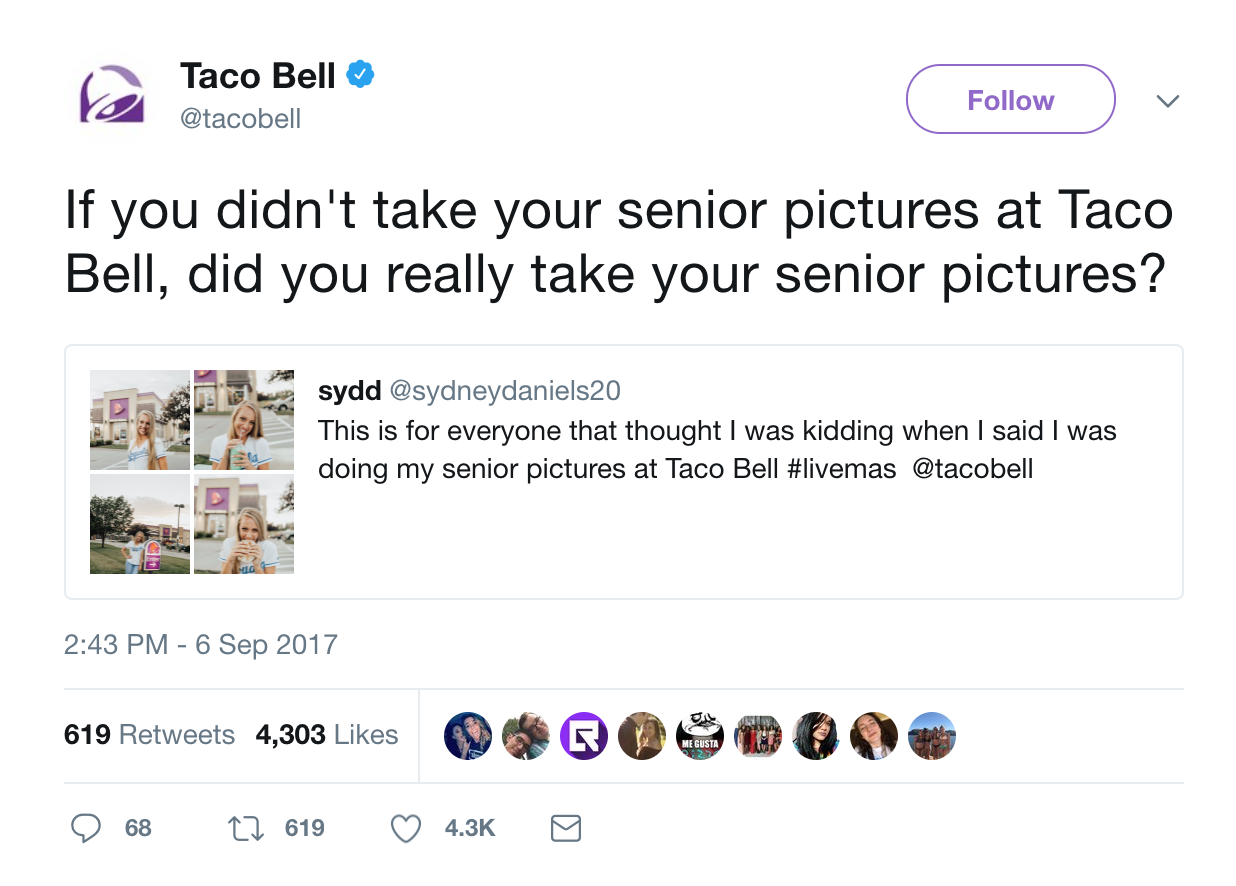
Taco Bell (@tacobell)
Taking senior portraits at Taco Bell has been a trend this year, and the brand took notice.

Chipotle (@ChipotleTweets)
Promoting their online ordering capabilities while disrupting everyone’s Tinder game.

Totino’s Pizza Rolls (@totinos)
Starting with the name of the account (Pete Zaroll) and the anthropomorphic pizza roll that personifies the account, this General Mills brand really brings the sass, especially when it comes to brand recognition.

Hamburger Helper (@helper)
Another General Mill’s brand, Hamburger Helper’s Twitter account has been in the news lately due to its quick-witted responses like this one:

DiGiorno Pizza (@DiGiornoPizza)
With a tagline like “It’s not delivery. It’s DiGiorno”, would you expect anything less than sassy tweets?

Old Spice (@OldSpice)
Never one to shy away from unconventional marketing and commercials, Old Spice continues that trend with their Twitter feed.

Innocent Drinks (@innocent)
This healthy smoothie/juice company based out of the UK has a Twitter feed filled with gems like this one below. What more could you ask for from a brand’s social media?

Moosejaw Mountaineering (@MoosejawMadness)
Self-described as “the most fun outdoor retailer on the planet”, Moosejaw’s Twitter is filled with funny quips like this one:

Have some more examples? Share them in the comments section below.

 Like this post? Read more at http://steverenner.com/blog-2/