Showing posts with label branding. Show all posts

Monday, April 22, 2019

Tips to Create Shareable Content in 2019


Social media likes are a type of currency. But shares are where it’s at for growing your reach. A share will organically generate more views to your post. If you get one share on a blog or social media post, it can domino into another, then another, and another, building brand awareness, expanding your reach and data footprint. All you have to do is create content worth sharing. How do you do that? Follow along.
Quality Over Quantity – But Pay Attention to Quantity.
The Internet is chock-full of tips on creating shareable content— however, you may find that much of the advice made widely available is so generalized and ambiguous it may not be helpful at all. Phrases that you may find are things like, “Posting good content guarantees shares and increased traffic!” That’s not false by any means, but what exactly is the proverbial “good content”?
Quality is a no-brainer. Audiences will share content that is relevant and of value to themselves and their social media network. Relevant content is built on audience research. Who is your audience? Who is your audience’s audience? Who do they follow? What do they already share? With the answers to these questions, you can start generating potentially shareable content.
By posting your content online, you’re just starting a conversation with your audience. The key now is to establish a back-and-forth rapport (you post, your audiences share; they post, you share). Ultimately, when done right, this can establish an ongoing relationship.
Titles- Not Just For Books
There’s a lot of content on the Internet. Millions of blog posts are published every day. Social media users and platforms are constantly increasing, and all of these writers and social media users are generating, liking, and sharing content, all the time. You need your content to stand out in the crowd. A good first step is to give them a title that really hooks your audience.
Start small. Use your general topic to come up with a few specific working titles, which are whittled-down, enough to guide the direction of your post.
Now make that working title, fun and unique. Test bold and strong language against more conservative and direct titles, and find the balance between the two. If you need to workshop your titles don’t be afraid to ask for second opinions. Having another opinion is valuable; don’t waste the chances you have to get one.
There are rules, guidelines, and tips galore on the web for you to find. Choose what works for you and your audience.
Note: People love to scan titles especially on Twitter, using an RSS reader or otherwise. Get them to take the next step and click-through with a title that is short, succinct, and interesting.
What Kind of Content Matters Too
Simple content is hands above more shareable. The way blogs and social media posts work is by making use of tidbits and clickbait. People generally respond very well to short form copy like lists and listicles. Your audience is busy, and the quickest way they can go through interesting and valuable content, the happier they will be.
SEO FTW
Although clarity and (sometimes) brevity is key to sharable content, making sure your SEO is well thought out can be a huge plus for reaching those that are maybe not already part of your consistent audience. Keep in mind that trying to over optimize your titles or posts can often sound awkward, and make your words sound like they were automatically generated for optimization by an SEO tool.
In order to effectively use keywords in your blog or social media titles and posts, research your potential customer base: What are they searching for? What problems do they face? How can you either help them directly or help inform them of other solutions? With the answers to these questions, you can choose and use relevant keywords, which will help you to become more searchable.
Note: Keyword rank isn’t the biggest barometer for success in search anymore. See this previous post to learn why.
A Picture Says A Thousand Words… (Infographics, Videos, and Other Visuals Can Too)
It takes more than a snappy title and intro for a post to be truly shareable. Images, infographics, videos, charts, tables, and block quotes can dress up and increase the influence of an otherwise text-forward post. Any visual you choose must, like everything else, be accurate and relevant. Use visuals to promote content that offers solutions to your audiences’ problems, in useful and creative ways, so that you can garner shares and valuable comments.
Tip: Don’t forget to read comments on your content. They’re an excellent measure of post success.

Thursday, March 15, 2018

Event Profile: SXSW 2018


South by Southwest (SXSW) in Austin, Texas has become a cultural mecca for music and film buffs, as well as a place for hosting interactive events that cover a range of topics from everything new in technology, to entertainment and advertising. There is always a huge amount of news coming from this week-long event, so here is a breakdown of what we’ve seen so far.


SXSW Trust Barometer

Every year, festival attendees are polled for the Trust Barometer, which measures the general feelings those attending have towards technology, business, and media. The results of this year’s poll brought up interesting discussions, as there is a very low amount of trust in emerging technology, one of SXSW’s biggest draws.

Most of the distrust comes from a shift towards a need for more human elements in technological interactions, and a distrust in blockchain technology, virtual reality, and autonomous vehicles. Discussions about smaller, more personal social media platforms were held, as well as conversations about the widespread use of bots and voice assistants and how the reactions to these technologies have become more and more personal, with users sometimes treating bots as though they were chatting with another human being. There is without a doubt a need to shift to more personal communication methods and develop an understanding of how emotional attachments can tie into interacting with these responsive communication technologies.


Experiential Exhibitions: ‘Westworld’ and ‘Ready Player One’

HBO hit-show Westworld and Steven Spielberg’s ‘Ready Player One’ both partnered with creative agency Giant Spoon to bring the worlds of the screen to life for festival attendees. These immersive exhibits allow you to step into the ‘Westworld’ town of Sweetwater and the Oasis of  ‘Ready Player One’ interacting with environments, actors in character, and becoming a character yourself. Read a review of the ‘Westworld’ exhibit on Forbes and Business Insider and see a walkthrough of Sweetwater here and the ‘Ready Player One’ exhibit here.


Speeches

SXSW is focused on cultivating the creative and entrepreneurial spirit throughout the world, and each day speakers from convergence, music, technology, and film focused paths present their take on various topics. The hope is to generate meaningful conversations about the state of the world in each of SXSW’s featured verticals. Notable speakers this year include Elon Musk, Melinda Gates, Darren Aronofsky, Sadiq Khan, and Esther Perel.


SXSW ends this Saturday, so there is bound to be more excitement in the last few days of the festival. For more SXSW news and live streams of keynotes and other events, visit sxsw.com.

Like this post? Read more at http://steverenner.com/blog-2/

Thursday, February 8, 2018

Essential Guide to Instagram for Business


Instagram is a valuable marketing tool for any business, which many marketers have known since the app was released. We’ve seen brands leverage the community to build their influence and brand awareness as well as increasing sales. But in early 2016, a new feature was released just for these businesses. Instagram for business allows marketers to leverage real data and account insights as well as create ads and targeted posts.These tips and tricks will help you leverage your Instagram business page today.
Get creative
Show off what your business does by creating content that isn’t expected. Focus on the solutions your products can provide for your customers, not just the products themselves. Sharing insider views of how your business functions on a day to day basis, and keeping up with what’s going on in the world and relating it back to what you’re doing is key, as well as keeping in mind that Instagram is a primarily visual platform. That means you need to keep your posts clean and well composed.  
Instagram Stories
If you aren’t already using Instagram Stories to further your content, you need to re-evaluate and work them into your marketing strategy. Stories are a great way to share things that are going on in your company that may not be worth creating a full post for but are also great for showcasing events, going more in-depth about what your posts are about.
Create consistent and authentic content
The content you create can and should be beautiful on its own, but it also needs to be consistent. Consistency means making sure you’re posting on regular basis or on a pre-set schedule, but also that each individual post fits in with the rest of your content. Paying close attention to your color palette is key to this, as well as posting content that is consistent with your brand’s image and communication style.
Respond to your followers
Customer service is a huge part of owning a business. You wouldn’t leave a customer to sit with an unanswered question in person, so making sure you’re engaging with your followers and people commenting on your posts or sending you direct messages. Communicating outside of just the posts you make is huge for projecting a good public image of your business to the outside world. Let your followers know that you are invested in them, so they feel they should invest their time caring about you.
Targeting Ads
If you’re familiar with Facebook ads and targeting through the Facebook ad management platform, you’re in luck. Instagram ads (specifically for business accounts) are managed in the same place and are set up in the same way. This includes location, demographics, and interests targeting, which ensures that your ads are being seen by exactly who you want.  
User-generated content or contests
Engage with your customers by hosting contests, giveaways or other incentive-based “events”. If you have customers post photos with your specific contest hashtags, you can easily track engagement and participation. Another great way to include your user base is to post user-generated content, either by reposting (and crediting) others’ posts or by having a channel “takeover” where an influencer or other user is able to post on your profile as themselves as sponsored by you.
Instagram is a valuable tool for marketers, and it’s easy to get started today. See how this always expanding social media platform can help you grow your business.
Like this post? Read more at http://steverenner.com/blog-2/

Tuesday, December 12, 2017

Marketing Trends To Expect in 2018


As 2017 comes to a close it’s time to look to the future to predict what will be the biggest trends in marketing. With only a month left in the year, now is the time to reevaluate your current strategies and start working on new ones to match the technologically focused consumer. Here’s what you should be looking for this coming year.

Death of organic reach on Facebook

In the past, it was easy to see results when marketing on Facebook just by having a page out for people to find. Those days are in the past, as many marketers are reporting decreased organic traffic, leading to slowed growth and decreased conversions from social media to the website. This is due to changing algorithms that make it more difficult for non-sponsored posts to reach into the newsfeeds of consumers, but also because of the steadily increasing presence of businesses on social media.

What to do:
Start investing in a paid Facebook strategy. Over 50 million businesses use Facebook, and most are feeling the effects of the shift from organic to paid reach. Buffer’s Facebook advertising guide is a great resource for those new to the process.

Landing pages

The landing page is often overlooked, but it is one of the fastest and least expensive ways to increase conversions. A website is always a necessity, but a landing page is a focused way to ensure that your customer is seeing exactly what they want or need to see without distractions and multiple calls to action that distract from the main goal.

What to do:
Build focused landing pages for each campaign. Follow these steps for great form optimization. Build more pages for more conversions. This Hubspot article will tell you why this is so important for growth.

Integrated influencer marketing

Influencer marketing has become increasingly important to marketers, and because Instagram is becoming (for many) one of the top social media platforms, the use and understanding of influencer marketing in all verticals is becoming a valuable tool.

What to do:
Prepare for a boost of companies using influencers, especially on social media. Many companies will begin building long-term partnerships with influencers, allowing them to become brand ambassadors. However, be aware of the FTC’s strict rules and regulations about endorsement posts. The key measurements to track this year for influencer marketing are KPI and ROI.  Learn the basics of influencer marketing here, and learn how to find the right influencers here.

Personalized content

Personalized content has been having a moment lately, and the moment will continue into the new year. Hubspot reports that personalized content does 42% better than non-personalized content. It is important to understand your audience and to use the new shift towards emotional content to engage with your customers and to increase that “shareability” of your content. Storytelling with creative content will be a big theme this year.

What to do:
Begin with gathering information about your audience, even if it is as basic as their name and email address. Make the content you use to acquire this something relevant that will grab attention and encourage conversions. With the information you gather, you can begin to target your users, and provide them with content that matches their needs and lifestyle. Read more about personalized marketing here.

 Like this post? Read more at http://steverenner.com/blog-2/

Monday, December 4, 2017

Holiday Ads of 2017


The holidays are right around the corner and the commercials that are airing right now are becoming more festive, heartwarming and gift focused. So far, these are some of the best ads from around the world this holiday season.  
Waitrose: “#ChristmasTogether”
John Lewis “Moz the Monster”
Marks and Spencer “Paddington & The Christmas Visitor #LoveTheBear”
Cost Plus World Market “The Performance”
Heathrow Airport “#HeathrowBears”
Apple “Sway”
Audi USA “Parking Lot”
Amazon “Give”
Old Spice “Ye Olde Exploding Yule Log”
Spanish Lottery “#DANIELLE”


Like this post? Read more at http://steverenner.com/blog-2/

Thursday, November 30, 2017

5 Rebranding Fails


Rebranding any company can be tricky business, and there is no guarantee you will always get it right. These five companies are proof of that. Check out some of the most hated, most ridiculously expensive, and most cringe-worthy rebranded and redesigned looks in recent branding history.
Tropicana Orange Juice- Underestimating brand loyalists

In 2009, Tropicana decided to change their look by offering what they thought was a sleek and sophisticated design ready for the modern market. After two months of the redesigned packaging being on shelves, sales had dropped 20%, meaning a loss of 30 million dollars. The design and campaign and the loss in sales cost the company more than 50 million dollars.  But why did it fail? Customers reported a deep emotional bond with the original packaging, and when the rebranding occurred, they found what they called the “ugly” design to be too close to generic brands or store brands and also worried that the product itself had changed, not just to look of the packaging. Read more about the Tropicana branding failure here.
Pepsi- $1 million for a complicated process
Pepsi Logo

Pepsi Logo (2009)

The logo itself released in 2009 wasn’t unsightly in the least, but the cost to end up with the final product seemed unjustifiable, especially if you look at the overly complicated design document for the project which talks about “Pepsi’s gravitational pull”, balanced energy fields and “numerical harmony”.  Pepsi’s logo has been changed about once every ten years, but their competitor Coca-Cola has hardly ever changed their logo.
Gap- the Gap in the gradient
Gap Logo

Gap Logo (failed redesign, 2010)

During the holiday season of 2010, a silent and disastrous event took place. Gap had launched a new, crowd-sourced logo (estimated to cost about $100 million)  to replace the original 20-plus year old one. The logo (bold black font to spell Gap with a blue gradient square) began to generate negative buzz in the design community and after only six days, Gap was back to using the tried and true original logo.
MasterCard- the color blob
Mastercard Logo (1996)

Mastercard Logo (2006)

MasterCard’s logo is one that is instantly recognizable, from the overlapping circles to their brand’s color scheme. There was, however, a time when the logo was not so attractive. In 2006, the two circles were marred with an off-center and out of focus third circle in between, with the name of the corporation “Mastercard Worldwide” (formerly Mastercard International) underneath it. From a design perspective, this short-lived logo looked rushed and sloppy, a far cry from the current iteration.  
BP- from green to black
BP logo prior to 2000 redesign
BP logo (2000)

In 2000, BP’s mission was to project their appearance of “green growth” which led the petroleum company to set forth and redesign their logo to reflect that. The green Helios sunburst which became the new face of the company had a rumored rollout cost of $211,000,000. When the logo was first released it was not well responded to, and it took time for the uproar and negative reviews to die down. Things stayed quiet for a while, but in 2010, the “green” company was responsible for what is considered the largest marine oil spill in industry history: Deepwater Horizon. For a company trying to promote themselves as “green” in an inherently not industry, this incident only furthered the outrage.

 Like this post? Read more at http://steverenner.com/blog-2/

Friday, November 17, 2017

The Best and Worst Ads of 2017


The Best

Fearless Girl, Agency: McCann New York
The winner of five Grand Clio awards was created by Kristen Visbal and commissioned by State Street Global Advisors. The award-winning and now iconic installation was placed in front of Wall Street’s Charging Bull to promote and celebrate International Women’s Day. The statue’s strength paved the way for McCann New York to win agency of the year, and for State Street to win advertiser of the year.
MailChimp “Did You Mean MailChimp?”, Agency: Droga5
MailChimp is already an established brand, but their first major campaign introduces them to a new audience in a way that subverts almost every expectation. By creating goofy and fun mispronunciations of their name MailChimp is able to prove that they are true to themselves and use creative ways to help their customer base.
Samsung “Ostrich”, Agency: Leo Burnett
Samsung’s tagline “do what can’t be done” refers to their virtual reality headsets and what you are able to experience when you put it on. This ad premiered during the product launch of the S8 and S8+ and used #DoWhatYouCan’t to further promote the new Samsung product lineup.
Audi “Daughter”, Agency: Venables Bell & Partners
Rated as one of the top commercials aired during the Super Bowl, ‘Daughter’ pushes for equal pay and employment opportunities for women, pushing for progress with #DriveProgress. Though not directly related to any specific Audi model, spokespeople for the company say that progress is at the core of the brand.

The Worst

Jennifer Aniston Smart Water campaign, Agency: AR New York
Bland print ads and unfunny attempts to go viral have plagued the bottled water company’s campaign with a very popular spokesperson. However, a bright spot in an otherwise unexciting campaign takes an aim at celebrity gossip: a video that shows Jennifer Aniston’s “leaked security tapes” revealing all of her secrets, from being pregnant to wearing a wig.
GoDaddy was once the king of scandalous ads, especially during the Super Bowl, but this year’s ad went in a different direction, poking fun at internet trends, from sneezing pandas and water bottle flipping, to “David After Dentist” and Rick Astley. The commercial itself was clever, but fell flat, with almost too much going on to effectively promote GoDaddy’s services.
T-Mobile #Unlimited Moves, Agency: Publicis Seattle
The Super Bowl commercial featuring Justin Bieber was in one word, underwhelming. Coming off of last year’s spot with Drake dancing to ‘Hotline Bling’, Bieber plays a “celebration expert” narrating touchdown celebrations throughout the years. Bieber is refreshingly down to earth, but his presence alone is not enough to give life to an otherwise unfunny commercial.
 Like this post? Read more at http://steverenner.com/blog-2/

Thursday, November 2, 2017

Marketing Tool: Generational Profiling


One size fits all marketing is a myth of epic proportions. Demographic profiling is one of the most important tools you can use when building a marketing campaign, and while demographics include language, location, age, and interests, generational profiling is another way to look at a broad overview of an age range. While not all members of a generational divide exhibit all of the traits that are common within the broader summary, embracing generational marketing is helpful for understanding prior influence and for predicting consumer behaviors. There are 5 major generations within our society right now, and each brings new experiences to the table. These profiles will help marketers understand these generational differences.
The Silent Generation (Traditionalists): Born 1945 and before
Members of this generation were children during World War II and were named the “Silent Generation” by TIME Magazine, because of the nature of the political and social world they had been born into. Because of the anti-communist beliefs, speaking freely was dangerous, and attempts to keep up a “clean” public image became much more measured. This generation was more financially cautious than their parents, especially after seeing the long-lasting effects of both the war and the Great Depression as young children. Statistically, this has always been a smaller generation, and as they age, numbers continue to dwindle.
Baby Boomers: Born 1946-1964
The Baby Boomers were free-thinking and spirited, generally moving away from traditional values held by their parents. Defining events for this generation included the civil rights movement, the moon landing, the rise of television and rock ‘n’ roll, as well as the assassinations of Martin Luther King Jr. and President John F. Kennedy. This was the first generation of children and teenagers to have an influential amount of spending power, and the generally low saving, high consumption lifestyle introduced a booming “youth-focused” culture, in fashion, music, and vehicles.
Generation X: Born 1965 to 1979
The anti-establishment Gen X-ers were rebellious, thinking in anti-consumerist ways and many were just beginning to gain traction in their careers when the great recession struck. Important events for Gen X were the introduction of personal computers, the AIDS epidemic, and the Watergate scandal. Gen X is called “America’s neglected middle child” by Pew, stuck between the loud, overspending Boomer, and the student-loan burdened Millennial.
Millennials (Gen Y): Born 1980 to 1995
Perhaps the most talked about generation right now, for better or worse,  Gen Y, or Millennials have been discussed extensively. Millennials are often called entitled and narcissistic and are known for being tech-savvy, environmentally and socially conscious, and creative. Millennials lived through 9/11, internet and social media growth, the fall of the Berlin Wall, and a revitalized pop culture. The weight of student-loans weighs heavily on this generation, with the entire generation carrying about $1 trillion in student debt, and 48% of employed college graduates working jobs they are overqualified for, according to Inc.
Gen Z: Born 1996 and beyond
The youngest generation currently, Gen Z or the iGeneration comes across a lot like millennials, but more intense. This generation has never been without the internet, and the understanding of technology is further along than before. Gen Z is the most diverse generation, and is also one of the largest generations, with a population of over 23 million. Gen Z is critical of big government, values privacy, and has a lower amount of optimism about the future than their millennial counterparts. The war on terror, the advent of social media and the great recession will all be defining factors for these young people.
Demographics are a key part of building a target market for any new marketing strategy, and part of that has become understanding generational differences to better understand influence and consumer trust. The relationship between marketing and generational profiles is not a new one, but it is something that changes rapidly, and thus needs to be continually analyzed.
 Like this post? Read more at http://steverenner.com/blog-2/

Tuesday, October 24, 2017

11 Herbs & Spices: Brands That Embrace Their Personalities on Twitter


Earlier this week, Twitter user Edge (@edgette22) noticed something funny about KFC’s Twitter page that made headlines for the brand.


The quiet execution of this comical marketing strategy isn’t the first time that a brand has used Twitter to subvert traditional marketing efforts for a more playful strategy. Think back to Wendy’s always sassy Twitter responses, like this one:

Fast food companies aren’t the only brands establishing themselves as Twitter masters, check out these examples of brands showing off their personality on social media!
Netflix (@netflix)
The streaming giant knows what it’s target audience is thinking.

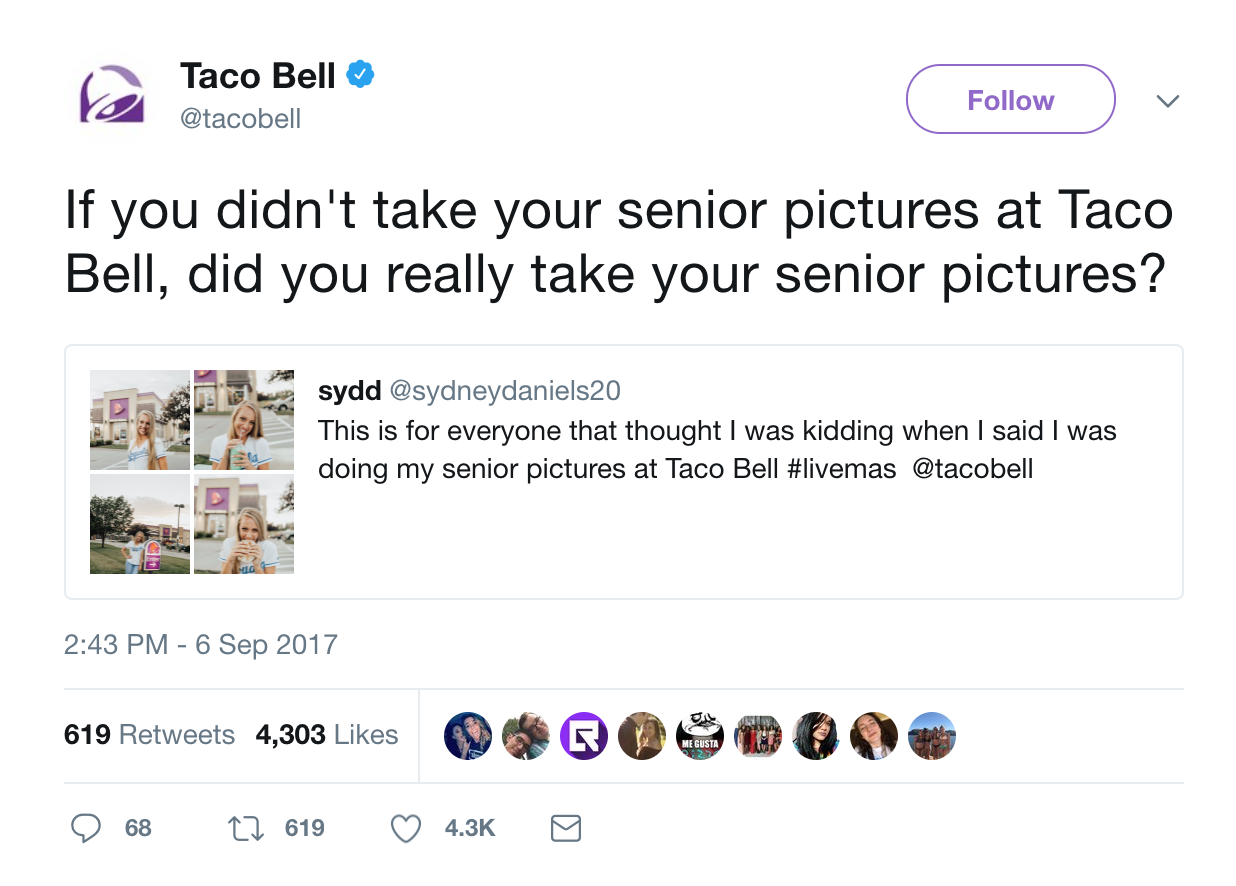
Taco Bell (@tacobell)
Taking senior portraits at Taco Bell has been a trend this year, and the brand took notice.

Chipotle (@ChipotleTweets)
Promoting their online ordering capabilities while disrupting everyone’s Tinder game.

Totino’s Pizza Rolls (@totinos)
Starting with the name of the account (Pete Zaroll) and the anthropomorphic pizza roll that personifies the account, this General Mills brand really brings the sass, especially when it comes to brand recognition.

Hamburger Helper (@helper)
Another General Mill’s brand, Hamburger Helper’s Twitter account has been in the news lately due to its quick-witted responses like this one:

DiGiorno Pizza (@DiGiornoPizza)
With a tagline like “It’s not delivery. It’s DiGiorno”, would you expect anything less than sassy tweets?

Old Spice (@OldSpice)
Never one to shy away from unconventional marketing and commercials, Old Spice continues that trend with their Twitter feed.

Innocent Drinks (@innocent)
This healthy smoothie/juice company based out of the UK has a Twitter feed filled with gems like this one below. What more could you ask for from a brand’s social media?

Moosejaw Mountaineering (@MoosejawMadness)
Self-described as “the most fun outdoor retailer on the planet”, Moosejaw’s Twitter is filled with funny quips like this one:

Have some more examples? Share them in the comments section below.

 Like this post? Read more at http://steverenner.com/blog-2/