Showing posts with label twitter. Show all posts

Monday, October 30, 2017

More Than The CEO: Hidden Talents of Business Leaders


Recently, a video surfaced of Alibaba CEO Jack Ma performing for employees at a conference dressed as Michael Jackson. This is not the first time that he has done something like this either. In 2014 he sang songs from “Lion King” for his employees, and now he’s at it again, less than a month after his Jackson performance, surprising everyone once again with his singing performance at a music festival hosted by Alibaba. Check out his performance here.
Jack Ma isn’t the only business leader with hidden talents though, these big names in the business world have hobbies and talents that may surprise you!
Jack Dorsey: Botanical Illustration
After launching a failed business in the early 2000s, Twitter co-founder Dorsey took a break to study Botanical Illustration (scientific drawings of plant anatomy) In an interview with the New Yorker he said: “I really like any colony-based structure, where you have a strong dependence on a network.”
Warren Buffett: Ukulele
When he isn’t making headlines as the CEO of Berkshire Hathaway, Buffett enjoys spending time with his family and practicing his hidden talent: playing the ukulele. He’s been featured on NPR and has even toured with his son. You can read the story of his journey to ukulele success here.
Sergey Brin: Trapeze
Brin has lived an exciting life as a co-founder of Google, and some of that excitement is found in high adrenaline exercises such as gymnastics, skiing, skydiving, and trapeze. Check out this video to see him skydive to promote Google Glass in 2013.
Mark Zuckerberg: Mandarin, sustainable living and more
The Facebook mogul has taken on a new challenge every year, setting personal goals like running 365 miles in a year, visiting all 50 states, learning Mandarin, and getting into sustainable living by only eating meat that he has killed himself. This yearly goal setting is great for him, and you might want to consider it as well to unlock these benefits.
William Clay Ford Jr.: Taekwondo
The great-grandson of Henry Ford and Executive Chairman at Ford was called the “Buddha of Detroit” by the New York Times in 2000. His zen approach to life and focus on environmentally friendly living makes him a mindful leader. Ford can probably accredit this to his study of Taekwondo, a Korean self-defense practice in which he has received his black belt.
 Like this post? Read more at http://steverenner.com/blog-2/

Tuesday, October 24, 2017

11 Herbs & Spices: Brands That Embrace Their Personalities on Twitter


Earlier this week, Twitter user Edge (@edgette22) noticed something funny about KFC’s Twitter page that made headlines for the brand.


The quiet execution of this comical marketing strategy isn’t the first time that a brand has used Twitter to subvert traditional marketing efforts for a more playful strategy. Think back to Wendy’s always sassy Twitter responses, like this one:

Fast food companies aren’t the only brands establishing themselves as Twitter masters, check out these examples of brands showing off their personality on social media!
Netflix (@netflix)
The streaming giant knows what it’s target audience is thinking.

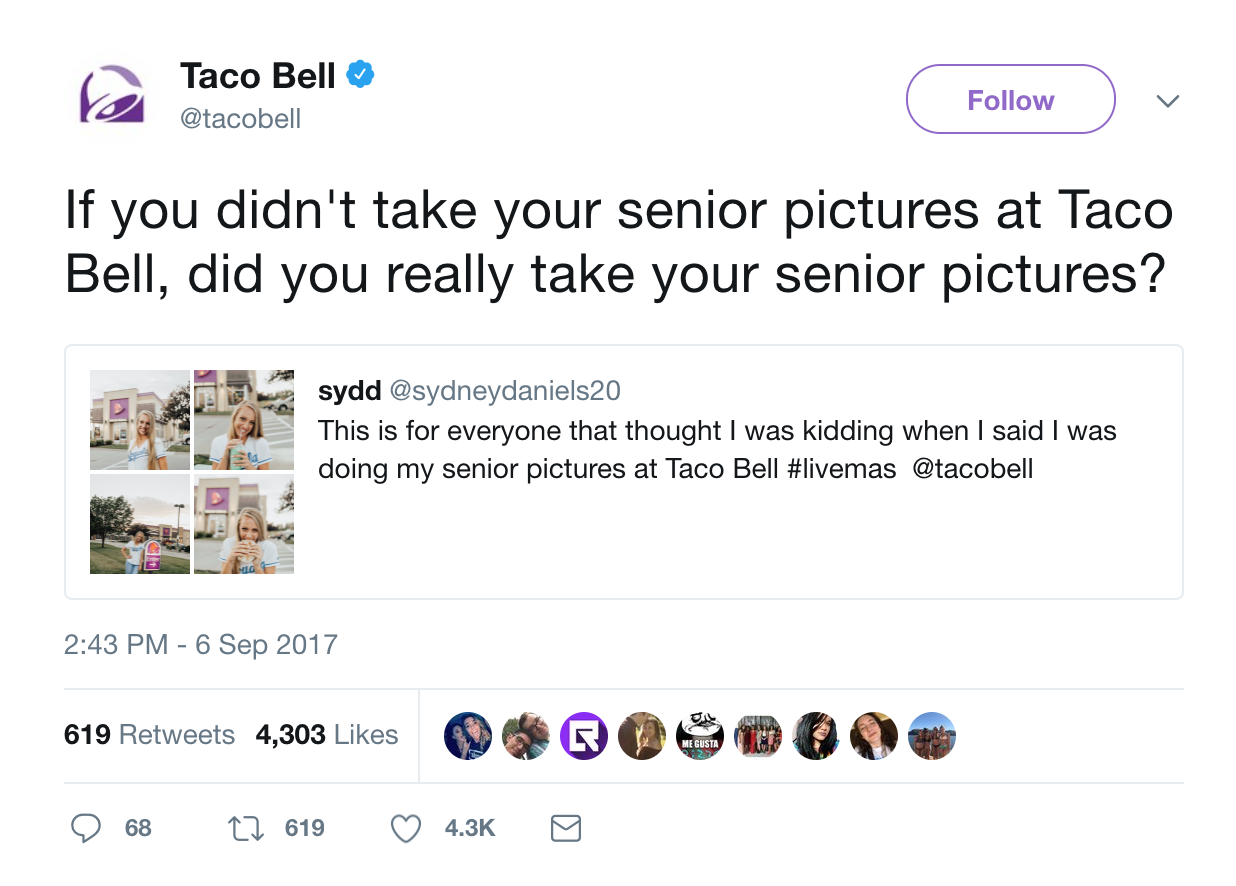
Taco Bell (@tacobell)
Taking senior portraits at Taco Bell has been a trend this year, and the brand took notice.

Chipotle (@ChipotleTweets)
Promoting their online ordering capabilities while disrupting everyone’s Tinder game.

Totino’s Pizza Rolls (@totinos)
Starting with the name of the account (Pete Zaroll) and the anthropomorphic pizza roll that personifies the account, this General Mills brand really brings the sass, especially when it comes to brand recognition.

Hamburger Helper (@helper)
Another General Mill’s brand, Hamburger Helper’s Twitter account has been in the news lately due to its quick-witted responses like this one:

DiGiorno Pizza (@DiGiornoPizza)
With a tagline like “It’s not delivery. It’s DiGiorno”, would you expect anything less than sassy tweets?

Old Spice (@OldSpice)
Never one to shy away from unconventional marketing and commercials, Old Spice continues that trend with their Twitter feed.

Innocent Drinks (@innocent)
This healthy smoothie/juice company based out of the UK has a Twitter feed filled with gems like this one below. What more could you ask for from a brand’s social media?

Moosejaw Mountaineering (@MoosejawMadness)
Self-described as “the most fun outdoor retailer on the planet”, Moosejaw’s Twitter is filled with funny quips like this one:

Have some more examples? Share them in the comments section below.

 Like this post? Read more at http://steverenner.com/blog-2/

Tuesday, August 15, 2017

Twitter is Dying, and Other Social Media Rumors


Social media gets a bad reputation for promoting the spread of fake news, but even the sites themselves get rumors spread about them. “Twitter is dying” has been a phrase that has been tossed around for years. The social media superpower has over 300 million active users, and more than 30 offices, so it certainly doesn’t seem like it’s dead. Find out what’s true and what’s false in the list ahead.
TWITTER
Twitter boasts a huge global reach and influence, but the reason people say it’s dying is because there have been numerous problems that have come up over the last few years. From issues with abusive users to leadership that makes decisions users dislike there seems to be a large disconnect between corporate decision makers and the users on the site. From a move to an algorithmic timeline (which introduced #RIPTwitter) to the potential introduction of a 10,000 character limit from the original 140 characters, taking away the core of what Twitter started out as, there is a general agreement that there is an inherent issue with how the platform works with those using it.  Twitter isn’t dead yet, but there have definitely been moves made that could cause a decline in use and eventual exodus from the microblogging platform.
VINE
The 6 second video sharing app and twitter go hand in hand. Twitter purchased Vine in October of 2012.  The short videos matched the short text posts perfectly, and the creativity began almost instantly. But the magic couldn’t last forever. In October of 2016, Vine announced that it would be phasing out its mobile app. This decision made users not only question Vine, but the longevity of Twitter as well.
FACEBOOK
No stranger to the rumor mill, Facebook and CEO Mark Zuckerberg are under constant scrutiny.  There have been numerous claims that the platform will start charging for having a profile (untrue, but continues to come up), or that privacy and ownership of content rules will be changing (the site released a statement in 2012 saying that their policies have been and will continue to remain the same as they have always been), and most recently the rumor that Zuckerberg will run for president in the next election (which he denies).
SNAPCHAT
Snapchat is one of the most popular photo sharing apps, and as such has been in the news for all sorts of reasons, good and bad. New features, the whispers that the introduction of Instagram Stories has hurt the quick sharing app, an IPO which many are calling a flop, and the rumor that the apartment spaces the company was using as offices in LA were not being lived in, not complying with regulations. Snapchat is known for secrecy, but when the entire world is online, no one is immune from rumors.
What social media rumors have you heard over the last year?
   Like this post? Read more at http://steverenner.com/blog-2/

Tuesday, May 9, 2017

5 Rules of Social Media


Every marketer has their own set of rules they live by for managing their social media presence. Maintaining strong and relevant social media can be difficult, but keeping these rules in mind as you move forward and develop your social strategy will ensure that you continue to grow your audience and influence.
1. Create Meaningful Content
Your content will be what engages and draws in your audience, so make sure that it is not only relevant but impressive as well. Using multiple types of content has proven to be the most effective strategy for many. Video, text, photos and infographics are all going to diversify what your profile looks like to your audience. In fact, posting different types of content can even grow your online reach and audience engagement.
2. Reach Out To Influencers
If traditional marketing efforts are not working as well as you may hope, or if things are working well but you’d like to continue to modify your strategy to be the most effective it can be, influencer marketing may be the next step. Influencers can validate your content, add their insights and grow your audience by exposing their own followers to your content and directing them back to your pages.
3. Build Relationships With Followers
If you have followers that leave you messages or comments, engage with them to get to the bottom of what you are doing right or what you can be doing better. From these relationships you can garner a better idea of who your followers are, what they want to see and how you can make the experience of your content more attractive to viewers. Companies that engage with their customer base have improved customer loyalty, simply because they are viewed as being more customer focused.
4. Post Consistently
You will notice that on pages with high engagement, reach and popularity, posts happen on a consistent basis. This is especially important when you are first starting out, as people that are finding your pages will expect there to be content, and for the content to appear on at least a semi-regular basis. If you are only posting once a quarter you are not allowing social to be used to it’s full potential. Ideal post frequencies can be found here.
5. Double Check Before Posting
Make sure that your content is accurate, doesn’t represent false facts and doesn’t act against the stance that you are trying to present. Double checking this is as important as double checking your spelling and grammar. One misstep can land you in the news and not for the reasons you would like. Besides maintaining professionalism, making sure your content won’t hurt you rather than help you is very important.
Social media is a great tool for your business, but there are absolutely right and wrong ways to go about how you use social platforms to grow and communicate. Use it the right way and you increase influence, grow your business, and have better and more personal customer/client relationships. Use it the wrong way and you can end up with a profile that gets no engagement, reaches none of your customers, and doesn’t move your business forward.
What social media rules do you and your business follow to reach optimum success levels?
 Like this post? Read more at http://steverenner.com/blog-2/

Thursday, March 30, 2017

Social Media For Business


The future of business may lie in social media, but why should a business spend time growing their profiles on these sites? These are just some of the answers…
1. INCREASED RECOGNITION
Visibility is everything. Any chance to publicize content is valuable and worth exploring. Social media is just that, another outlet for your brand and company voice to be broadcasted to the masses. This is important because it makes it easier and more accessible for new customers, as well as familiar and recognizable for existing customers.
2. STRONGER BRAND LOYALTY
Brands that are engaged with their customers on social media have higher brand loyalty. Social media doesn’t have different and elusive rules about customer service. Just as a genuine smile and pleasant disposition go far at a storefront, polite, timely and engaging responses on social media do wonders for brand reputation and loyalty.
3. EXPANDED CONVERSION OPPORTUNITIES
Every post you make on a social media platform is an opportunity for customers to convert. When you build a following, you’ll simultaneously have access to new customers, recent customers, and old customers, and you’ll be able to interact with all of them. Every post, image, video, or comment you share is a chance for someone to react, and every reaction could lead to a site visit, and eventually a conversion. Not every interaction with your brand results in a conversion, but every positive interaction increases the likelihood of an eventual conversion.
4. HIGHER CONVERSION RATES
Social media is a place where brands can act like people do, and this is important because people like doing business with other people; not with companies, this is the humanization effect. Another factor is brand equity, higher number of social media followers tends to improve trust and credibility in your brand, representing social proof. The value of building a strong social media community will improve your brand’s worth to investors, bloggers, media, and potential customers.
5. INCREASED TRAFFIC
Website traffic is the bread and butter of any business’ digital life. Without social media, traffic is limited to those that are already familiar with your brand or those searching through your ranked keywords. Every social media channel added is another hook that baits back to your site, and any content produced and published carries with it endless potential for new visitors. The more (quality) content produced equals more traffic, with more traffic leading to more leads and more leads to more conversions… Money in the bank.

Like this post? Read more at http://steverenner.com/blog-2/

Wednesday, February 8, 2017

Best Marketing Apps for Small Business


Larger enterprises have the luxury of having several hands on deck helping with different aspects like marketing or sales. However, we all know that small business owners wear different hats, sometimes all of the hats. In order to streamline processes for busy entrepreneurs and small business owners here is a list of free easy to use apps to help with online marketing.
Asana
Asana is a platform designed to help businesses track work from projects, to conversations, to diversified notification types. The app is a dream for all the multitasking entrepreneurs that delegate or need to delegate work with their team. Streamlined processes and transparent work flow are some favorite features.
Google (Docs/Messenger)
Google Docs is a one of the most efficient ways for teams to share content. From slides, spreadsheets, documents, email and messenger Google is the one stop shop. Business partners and employees can collaborate and chat all in real time.
Facebook Pages Manager
Facebook is currently one of the biggest and cheapest ways to market your business online. Having a business page that is active and engaged is imperative for your business. The Facebook app is a simple and convenient way for keeping on top of scheduled posts, and answering direct messages from customers in a timely manner.
Twitter
Twitter has been having a pretty tumultuous time in the social media realm but don’t let that deter you. One of the fastest ways to go viral, easiest ways to be engaged with your audience, and staying in touch with current events is still Twitter. The app is one of the easiest to use with great UI/UX and a small learning curve.
LinkedIn
LinkedIn is the place to be especially if you run a B2B business. Although it can be difficult to reach an outside market, and despite ads being a bit pricey, LinkedIn is one of the most reputable social media platforms. It brings a large sense of legitimacy, and can help you find targeted leads. The app can have a bit of a learning curve but is manageable after a few uses.
Instagram
Instagram is one of the fastest growing social media platforms right now. In the past few years they have added features that include business pages, live video sharing, and simple searchability. It’s a great place to showcase company branding and culture all in a sleek and clean app that’s extremely user friendly.
Fiverr
Fiverr is for all the entrepreneurs that sometimes need to outsource some duties. It’s an amazing marketplace to find nearly every kind of serve for your business for literally any price range. The website and app can be a little confusing to maneuver at first, as there are quite a few moving parts, but it’s well worth it.
Canva
Canva is made to help all the design challenged entrepreneurs create practical, aesthetically pleasing and professional looking images for social content, print material or email blasts. Canva has created templates for beginners and opened up a platform with enough artistic freedoms to those with a better understanding of design, or those who want to to learn.
MailChimp
MailChimp is one of the world’s largest email marketing services. Email marketing is still considered one of the top tools in the marketing world, and MailChimp makes the process of sending out those campaigns easier than ever. With an easy to navigate website and app, Email marketing is made accessible even for beginners.
Mashable
Mashable is one of my favorite websites for keeping your ear to the ground as it relates to all things business, tech, social media, popular culture and where they all collide. Keeping up with the times is a great way to stay ahead of popular trends, find curated content and stay engaged with your customers.
Like this post? Read more at http://steverenner.com/blog-2/

Friday, November 18, 2016

The Secret to Building Your First 100 Twitter Followers


I regularly speak to clients, business contacts and people at our conferences who want to use Twitter more, or who have struggled with getting past the initial stages of using the site. If you are an experienced Twitter user, then hopefully you’ll still be able to share this post with friends or clients who are just starting out in building their brand or their own profile on the site. 
Getting Started
There are plenty of guides and blog posts that cover the basics of signing up for Twitter account and advice about how to use the site in general. Twitter has released their own Twitter for Business minisite, and Mashable have compiled a number of blog posts into a Guide Book.
I think it’s valuable to think in terms of building an early base of followers, since the flywheel effect comes into play beyond a certain threshold. I would pick the number 100 as a target where anybody can say that they’re beyond the ‘beginner’ stage, and where all the advice from the other guides becomes much more applicable.
Preparing for Promotion
If this is a brand new Twitter account, the first few tweets will demonstrate that you’re actually using the service and lets potential followers know what to expect. This makes gaining followers a little easier.
After creating the account, you should immediately try to publish a few interesting tweets. If there are things on your mind about your industry or area of expertise, then make a comment or two. You could make insightful remarks about your niche or publish links to useful or interesting content (though avoid promoting your own content at this stage.) You could even supplement these tweets with less formal comments, such as something funny, a comment about something that’s been bothering you, or just mention when the weather is going to change.
You can also share images and photos. When photos are shared through certain prefered services (such as Twitter’s mobile apps, yFrog, TwitPic and Instagram), they will be added to your own photo gallery. Thumbnails of these pictures will be displayed on your profile page, which will make your profile look more interesting and can encourage people to follow you. 
First 100 Followers
Depending on the existing influence of you or your company, your first 100 followers might be stunningly simple to find, or particularly difficult. I’ve suggested some straightforward ways to build this solid base of followers.
Your Friends & Contacts
The first batch of people you engage with could be coworkers, friends, clients or partners. Aim for people with whom you have a close relationship, so that you can simply email or ask them directly; friends won’t mind you asking, and you could easily pick up your first couple of dozen followers this way.
Your Blog
You can promote the account on your blog, by writing about it and explicitly asking people to follow you. (These readers can visit your Twitter profile to see the types of thing you’ve published already, and make a decision about whether to follow you.) Your blog should be a great source of followers, since the readers are already a self-selected group that trust you enough to subscribe and are interested in what you have to say: this translates well to having an interest in following you.
Email Lists
If you have an email newsletter that gets sent to certain people, you could use that list to promote the account as well. If you have separate lists for different audiences, it’s worth trying to tailor your description to each of them.
For example, a recruitment company with an email list of HR Managers could tell them something like “We’ll be sharing new advice from our recruitment agents about finding and retaining the very best employees.”
Meanwhile, the same company’s email to job-seekers might say “I’ll be publishing the best new job listings on Twitter, so you could find out about the hottest opportunites before anyone else.”
Promoting your Twitter handle
You should also begin using your Twitter username on and off the web, so that people can find and follow you without you explicitly asking them to. There are many easy ways to do this such as:
  • Include a link in your email signature
  • Add your Twitter URL / Name on print media such as business cards and flyers
  • Consider including it on any advertising
  • Include a link to your Twitter account anywhere you participate online, such as in forums or when blogging.
Finding People to Follow
Through your regular use of Twitter, you’ll discover interesting and relevant people to follow. However, it will be important to find some relevant people to follow early on.
The focus should be on accounts who you are legitimately interested in following or talking to. For example, suitable accounts might include:
  • Interesting or well connected people from your region
  • Local companies, restaurants, events, etc.
  • Other accounts focused on your business niche
  • People with similar interests to you, etc.
Three particular methods for finding these people are listed below:
  1. Twitter Search
Twitter’s advanced keyword search tool (more details below) will let you find people who are tweeting about particular topics. It also allows you to restrict your search to a geographic area. For example, I might look for “seattle mariners” or “520 bridge” to find people have an affiliation with or live in my area.
  1. Twitter Lists
The official ‘Lists’ feature allows you to view user-generated lists of account. Finding lists created around a particular topic may give you a selection of people worth following. (TheNextWeb has more information about Twitter lists.)
You can find the lists that a particular user has created by following the ‘Lists’ link on their Twitter page.
  1. Third Party Services
There are numerous third-party sites to help discover users on Twitter. We also recommend third party services such as Listorious, WeFollow and Twellow to search for relevant groups of people.
One of the most useful services, FollowerWonk allows you to search the profile bio text of Twitter users, which can help to find users in particular niches or local regions.
Sharing Content
There will be two distinct types of tweet that you publish. The first type is one which you decided to write, independent of others. The second are is reactive to what else is happening on Twitter. Early on, I recommended that you post tweets of the former at least once or twice a day. These updates could include:
  • A comment from you that demonstrates expertise of thought leadership in some aspect of your niche
  • A link to news or blog content that your followers might find interesting
  • Photos that are either taken yourself or found online
In addition to creating content, it is important to engage with users more directly. At minimum, this should include checking and responding directly to direct messages (DMs) and @ mentions from other users. (The @Connect link on the site lets you see people who have mentioned or responded to you. In addition, various smartphone apps will alert you when someone mentions you in a tweet.)
We recommend checking relatively frequently and responding to these messages quickly. Whether people are asking you a question or just mentioning you, a quick response will be well received by the other person.
Other Conversations
In addition to seeing things that people have said explicitly to you, scan through the content posted by the people you follow. Are there interesting posts that you would like to comment on, or conversations that you’d like to join? Go ahead and respond to anything that people have posted.
Remember that people on Twitter don’t mind receiving responses or comments from people they’ve not talked to or met before. Don’t feel you have to stick to any off-line social conventions about butting in to a conversation: this is Twitter, and people have only posted content looking for a reaction or response.
Like this post? Read more at http://steverenner.com/blog-2/
Monday, November 14, 2016

20 Tips on How to Repurpose Content


Creating high quality content is a highly important aspect, not only for gaining high ranks but firstly for making users or readers happy. Yet, we all know that running a blog with constant valuable and high quality content might sometimes be difficult as it is a resource-consuming process.
You sometimes don’t want (or don’t have the means) to reinvent the wheel every time you create a new piece of content. Therefore, why not get the best out of the content that you’ve already worked on?
All you need to do is repurpose the content you already have. Not only will you save resources, but you’ll also extend the reach of your blog and maybe find new ways to reach your audience. Finding the proper ways to repurpose content could sometimes be a challenge. This is why I’ve put together a great list of the best ways to repurpose content:
  1. Convert Your Old Blog Posts Into Hands On Guides
After having written about topics in the same field for a while, you eventually start to amass enough information and expertise to be able to train someone in the field (at least at a basic level). That’s true of all fields, not just SEO (think cooking, programming, DIY etc.) So why not put all that knowledge to use and create a guide on how to do something by collating parcels of valuable information you’ve distributed across many posts over time into one neat, organized, easy to follow user guide? Manuals, if written and edited in a clear and intuitive form, can have a very high re-reading value, as they are useful both as a beginner’s lecture as well as a reference book later on.
  1. Turn Your Already Published Content into Podcasts
People still like to listen to other people talking. They just don’t want to tune in at a certain hour to be able to do it. So, podcasts are really the TiVo version of radio shows: they can be quite entertaining and/or enlightening and don’t require you to be active and can be “digested” any time you choose to. That last factor really hits a sweet spot in terms of convenience and accessibility: how many articles/videos can you read/watch while driving, running or doing house chores? The serial form also helps introduce new avenues and experiment with content and form, as long as you manage to ensure a certain level of technical quality. Even if some attempts might fail, listeners usually come back to a Podcast they like, once the initial attraction has been established (just like a TV show, not all episodes are going to be great, but you’ll always tune in to watch the show).
  1. Make Use of Your Internal Data and Put It Together into Case Studies
If you like churning out copious amounts of data in the hope of finding useful trends that might inform your choices, there’s re-use value in analyzing those data. Of course, you might be more interested in the quantitative aspect, but there’s plenty to learn (especially for others) from a more qualitative approach. Trying to understand why something happened in terms of cause and effect can be very rewarding and it is an intriguing mental exercise, both for you, as the person behind the analysis, and for the reader, as a virtual Dr. Watson. A good case study is less rigorous than a study, but also more demanding from a creative stand point and if done right, it can get you an equal amount of fame.
  1. Gather All Your Interviews into an Expert Advice E-book
If you end up doing enough interviews on a topic, you could try to compile them all into an expert advice e-book. There’s plenty of advantages to an e-book alone (more on that below), but there are some specific advantages of expert advice e-books. For starters, there’s not that many of them; even the first pages of a Google Search don’t turn up that many relevant results, which is not the case for most of the other examples in this list. The reason might be that it’s hard enough to get one piece of expert advice, let alone get enough of it to publish a book. There’s also the advantage of not having to come up with content on your own (though you still have to make the interviews happen).
On top of that, when the advice is coming from a variety of recognized experts, there’s a higher chance people will find it more relevant or more persuasive than if it came from a single source. Of course, you’ll still have some input in terms of structure, design and segueing the different sections of the book into one coherent story and that might be exactly what makes it possible to publish that content as an e-book, as opposed to letting it linger scattered throughout various pages on your website.
  1. Transform the Quora Q&A into Valuable Blog Post
There’s value in having your post read, commented upon and shared with others. But there’s also value in opening up your content for a full and unforgiving debate. Which is what is likely to happen if you were to post some of your ideas as an answer to someone on Quora. Or if you were to use your content to stir up a discussion on a Reddit thread. Even though these two examples are quite different in a lot of respects (starting with the type of platform they represent), what they have in common is:
  • A significant amount of experts who contribute to the platform (more visibly so on Quora, but present on Reddit as well) and
  • Sets of involved core contributors and a strong sense of ethics.
So, while the reward might not always be an easy win, you can be sure that it will be the result of serious consideration and much exposure of your content and yourself.
  1. Share Your Statistics Through Twitter Posts
Micro-blogging (as Twitter is usually defined) is all about saying a lot with very few words. Of course, brevity can also be achieved through images and that’s where things can really take off. The same information can be presented in a myriad ways with a different impact every time. When it comes to “share-ability”, nothing beats a well-designed statistic. Besides, a well-made infographic is not just eye-candy, but also a valuable educational tool.
  1. Update Your Old Posts with New Information
Your content should be a “living” thing, as much as possible. It partially means that, as you get a clearer or more complete view of reality, you update previous posts with the newfound knowledge. It’s not as much about recycling as it is about bringing things back into relevance with a new more insightful look at them. Just as you initially thought a certain SEO tactic was good and useful, others may have believed the same. So coming back now, after additional research, and proposing a more nuanced approach, could help others as well. It might also help people who are new to the discussion and didn’t have a chance to witness the original post and the comments around it.
  1. Create New Blog Posts and Articles from Spinoffs
Once you’ve tackled a subject, it doesn’t mean it’s a done deal. Innovation is rife in every field, particularly technological ones, so what you found to be true last year might not apply anymore (or what you found to be true last month for that matter). So much like in Hollywood, sequels are a likely occurrence. There are many reasons why a follow-up article might be relevant: something has changed and there are now more reasons to do (or not do) something, or more ways of doing it; you’ve interacted with readers and industry experts in the meantime and discussed the topic, finding out that there are more worthy items for your list than you could have thought of initially; one secondary “character” in your original article has now suddenly become more relevant and can be the protagonist of their own article or blog post, etc. Whatever the case might be, seize the opportunity and expand your article pool.
  1. Create A Slide Deck & Upload To SlideShare to Reach New Audience
You can turn your content into a slide deck presentation and upload it to sites like SlideShare. The site allows you to search slide decks both by topic and user, giving uploaders the benefit of a “channel”-like fame. Despite the general feeling of “death-by-powerpoint” in class and corporate settings, going through a presentation on your own can be quite an entertaining prospect. It’s more engaging than a paper and more interactive than a video. Moreover, it allows you to impress the reader on more than content (think about how important design is and how much it can say about you).
  1. Build an Infographic to Make the Best Out of Your Old Content
Creating a good infographic can be quite challenging. It needs to show all the relevant information, do away with any redundant or useless data, make sense, have scientific validity while also catching the eye of the casual viewer by being both original and good-looking. In fact, it might be less difficult to gather the info you want to present to your audience than to design the way you’re going to present it. But it might be worth the price of admission: a well-crafted infographic will be shared, liked, commented, shared, included in mainstream publications, shared, etc. Besides, you don’t have to start from scratch or have a team of wiz-designers, as there’s plenty of templates and tools to go around if you’re just starting out.
  1. Put Your Current Content Together Into an E-book
When you’ve published content for long enough, you might think that you’ve got enough material there for a book. And that might just be true. So if that’s the case, why not actually create a book, or rather an e-book? There are advantages to an e-book both for you and for your readers. As a publisher, an e-book offers you tremendous flexibility and variety in terms of structure and design, allowing you to come up with an absolutely unique product. As a reader, an e-book is easy to carry and easy to access (whether it’s on a laptop, tablet, mobile or e-reader). It also doesn’t take up too much space (if any at all), you can easily navigate between chapters and sections, as well as highlight or bookmark paragraphs or pages.
  1. Write Guest Posts on Topics You Already Have Expertise On
Being knowledgeable on a topic means you are no longer confined to just your own soapbox, but you can jump on others’ as well (at least for a short while). Once you have enough expertise on a topic or niche, you might have what it takes to write guest posts for other people, who might have entirely different audiences than you have. There are plenty of websites that allow for guest posting and quite a few pieces of advice on how to do it successfully and get the most out of it.
  1. Promote Your Existing Blog Posts from Multiple Points of View
This one is pure marketing at its best. The modern-day culture equivalent of this would be the recent trend of having multiple teasers and trailers for a movie. Which is pretty much what you’d be doing: selling your post from multiple points of view (and for multiple audiences, potentially). This way, you can be sure that when you’re sharing a different image and a different tip every day, you might pull in a different crowd. People love variety in lists, because it means that if they don’t like one suggestion from your list, there’s a lot of other ones they can try.
  1. Turn Your Existing Content into Videos
Our culture has increasingly turned from reading to visual. This is apparent not just from the tremendous amount of video content uploaded each day to YouTube and other similar sites, but also from the pervasiveness of video content on pretty much every other platform that’s not dedicated to video management (such as websites, blogs, social networking sites, etc.) That’s where the great advantage of turning written content into a video lies. A written post tends to signal effort, saying “Hi, you’ll need about 5 minutes to read me, 10 if you’re tired”. A video doesn’t say anything, it just gives you no warning. Especially on mobile Facebook, videos are just meant to start running as you scroll down. If something catches your eye, you’re likely to watch it until the end, even if you wouldn’t have clicked on it otherwise.
  1. Conduct Podcasts with Industry Leaders Following Themes You Are Already Familiar with
The most important elements that can influence the success of a Podcast are not necessarily related to what you say. Not because content is irrelevant (it totally is), but because the responsibility of providing said content does not need to rest solely on your shoulders. In fact, you can build a sustainable strategy based mostly (or entirely) on interviews, whether it’s with authors, musicians, comedians or any other type of expert. So if you don’t feel confident enough to dispense advice of your own, why not try to get industry leaders to give it? It requires an entirely different set of skills, but it also comes with some built-in advantages (like the fact that industry leaders already like to talk about how and why they’re industry leaders, so you’ve got half of your work cut out for you).
  1. Compile Your Clients’ Questions from Support into an FAQ Page
FAQs are seriously underrated. They represent compilations of useful information which has been statistically proven to come in hand. How could you not be interested in that? As with pretty much every other example in this list, there are rules to how to create good FAQs, both in terms of content and structure and in terms of design.
  1. Pull out the Best Questions You Get on Support and Turn Them into Individual Blog Posts
If you’re running into writer’s block, let your audience be your muse. With experience and knowledge you gain not just information but also a certain way of thinking about things. Which means you also lose a certain way of thinking about them—a more naive, but very likely original one. So it should be no surprise that some of most interesting questions you will try to answer will come from your readers, people who are counting on your help to further their knowledge. Of course, there are many websites out there which bring people together and which can be used to get answers to one’s burning questions. But, nothing beats keeping a personal relationship with your readers and trying to find an answer even when you don’t know what it might be beforehand. Besides, if your readers themselves have blogs or websites, turning one of their questions into a full post might yield a significant amount of good-will in terms of relationship building.
  1. Convert the Testimonials from your Users into Quality Content
There’s something in the way Users learn from their peers that can’t be matched by the traditional interaction. Seeing someone else who’s just like me using your product and being successful is likely going to be more effective than all the data in the world. Of course, you can’t just throw people’s words out there and hope they will inspire, you have to pay attention to how and when you do it and always try to stay true to the original message, as it was written/recorded.
  1. Make Use of Your Clients’ Photos or Videos Using Your Product
This is an even more powerful variation on the testimonial. It’s also a bit removed from the testimonial, as it can be less of a proactive initiative, and more of a fair exchange. That being said, it’s still a true message. You’re not asking your clients to make up things, or pretend they like your product when they really don’t. It can be a video that they themselves come up with, or something you’re putting together and they just agree to show in it. Either way, the customers’ presence in the video needs to feel real and honest. It might even be more persuasive if the experience shown is not 100% positive (maybe they had a difficulty in the beginning, but they overcame it, or maybe they didn’t know how to use a functionality, but your customer support provided a solution).
  1. Mix Your Blog Posts Into Valuable Online Courses
All content can be educational, but depending on the form in which it is presented, some instances are more effective than others (and they usually involve making learning an active process where the learner has goals and incentives to achieve them). With a little bit of editing effort and some understanding of the psychology of learning, you could take existing interviews, blog posts, Q&As etc. and turn them into a series of (short) online courses.
Hope you’ll get the best out of these methods of repurposing content. If you know some more other great ways of repurposing content, just let us know in the comments.

Like this post? Read more at http://steverenner.com/blog-2/