Showing posts with label Shareable Content. Show all posts

Monday, April 22, 2019

Tips to Create Shareable Content in 2019


Social media likes are a type of currency. But shares are where it’s at for growing your reach. A share will organically generate more views to your post. If you get one share on a blog or social media post, it can domino into another, then another, and another, building brand awareness, expanding your reach and data footprint. All you have to do is create content worth sharing. How do you do that? Follow along.
Quality Over Quantity – But Pay Attention to Quantity.
The Internet is chock-full of tips on creating shareable content— however, you may find that much of the advice made widely available is so generalized and ambiguous it may not be helpful at all. Phrases that you may find are things like, “Posting good content guarantees shares and increased traffic!” That’s not false by any means, but what exactly is the proverbial “good content”?
Quality is a no-brainer. Audiences will share content that is relevant and of value to themselves and their social media network. Relevant content is built on audience research. Who is your audience? Who is your audience’s audience? Who do they follow? What do they already share? With the answers to these questions, you can start generating potentially shareable content.
By posting your content online, you’re just starting a conversation with your audience. The key now is to establish a back-and-forth rapport (you post, your audiences share; they post, you share). Ultimately, when done right, this can establish an ongoing relationship.
Titles- Not Just For Books
There’s a lot of content on the Internet. Millions of blog posts are published every day. Social media users and platforms are constantly increasing, and all of these writers and social media users are generating, liking, and sharing content, all the time. You need your content to stand out in the crowd. A good first step is to give them a title that really hooks your audience.
Start small. Use your general topic to come up with a few specific working titles, which are whittled-down, enough to guide the direction of your post.
Now make that working title, fun and unique. Test bold and strong language against more conservative and direct titles, and find the balance between the two. If you need to workshop your titles don’t be afraid to ask for second opinions. Having another opinion is valuable; don’t waste the chances you have to get one.
There are rules, guidelines, and tips galore on the web for you to find. Choose what works for you and your audience.
Note: People love to scan titles especially on Twitter, using an RSS reader or otherwise. Get them to take the next step and click-through with a title that is short, succinct, and interesting.
What Kind of Content Matters Too
Simple content is hands above more shareable. The way blogs and social media posts work is by making use of tidbits and clickbait. People generally respond very well to short form copy like lists and listicles. Your audience is busy, and the quickest way they can go through interesting and valuable content, the happier they will be.
SEO FTW
Although clarity and (sometimes) brevity is key to sharable content, making sure your SEO is well thought out can be a huge plus for reaching those that are maybe not already part of your consistent audience. Keep in mind that trying to over optimize your titles or posts can often sound awkward, and make your words sound like they were automatically generated for optimization by an SEO tool.
In order to effectively use keywords in your blog or social media titles and posts, research your potential customer base: What are they searching for? What problems do they face? How can you either help them directly or help inform them of other solutions? With the answers to these questions, you can choose and use relevant keywords, which will help you to become more searchable.
Note: Keyword rank isn’t the biggest barometer for success in search anymore. See this previous post to learn why.
A Picture Says A Thousand Words… (Infographics, Videos, and Other Visuals Can Too)
It takes more than a snappy title and intro for a post to be truly shareable. Images, infographics, videos, charts, tables, and block quotes can dress up and increase the influence of an otherwise text-forward post. Any visual you choose must, like everything else, be accurate and relevant. Use visuals to promote content that offers solutions to your audiences’ problems, in useful and creative ways, so that you can garner shares and valuable comments.
Tip: Don’t forget to read comments on your content. They’re an excellent measure of post success.

Thursday, January 17, 2019

Facebook’s New Podcast


It seems Facebook has its hands in a little bit of everything lately. From Facebook Portal, the Amazon Alexa enabled communication device to their new channel Facebook Watch, which houses videos from channels users follow as well as original content, there seems to be quite a move for Facebook to stay prominent in every channel, now including, podcasting.
A brand new podcast series focusing on entrepreneurship is the second podcast series to be released by the social media giant, and the first to be released in the US. The content is no surprise given the volume of businesses that use the platform (more than 90 million currently).
Called ‘Three And A Half Degrees: The Power of Connection,’ this show plays off of how technology has made it more convenient to connect (No longer six degrees of separation, but more like three and a half with the advances we have made).
Podcast host and VP of Business and Marketing Partnerships David Fischer says the podcast falls in line with the platform’s mission of helping businesses learn from one another.
Episode one includes an interview with Blake Mycoskie, the creator of TOMS shoes, and founders of fellow charitable business Two Blind Brothers, Bryan and Bradford Manning, and focuses on brands that prioritize a social mission over their growth or profit.
Season one will be seven episodes with fourteen guests, including Gary Vaynerchuck, Chris Kempczinski, Beth Comstock and more.
You can find episode one of ‘Three And A Half Degrees: The Power of Connection’ on Apple Podcasts, Spotify, Google Podcasts, TuneIn, and Stitcher.
Like this post? Read more at http://steverenner.com/blog-2/

Tuesday, August 14, 2018

Engagement Insights For Facebook Business Pages


In January, Facebook announced a change to its news feed algorithm that would prioritize personal content from family and friends over content from Pages, which caused panic for many businesses that rely on Page engagement for growing their brand and generating new leads. Buffer and BuzzSumo collaborated to analyze 43 million posts from the pages of the top 20,000 brands on Facebook, and this is what they found.
Page Engagement has dropped
It was broadly assumed that with the algorithmic changes there would be a decrease in brand engagement, but the amount of decline was up in the air. Now, after the changes, Buffer’s study discovered that engagement on brand pages has dropped over 50%, with post engagement falling nearly two-thirds from where it had been previously.
Page types hit with a drop in engagement
The study ranked ten-page categories to determine which type of page was hit with the largest engagement drop. Artist Pages were found to be affected the most with a 70.6% drop in engagement, and retail Pages were affected the least with less than a 50% drop.
Pictures not video content
There has been a huge push for video content, and Facebook is leading the charge on that with a focus on live video and original content streaming (both live and pre-recorded) through Facebook (Watch, IGTV); but this study found that the content that received the highest engagement was not video, but images. Despite that, interaction for all content types is down, with an over 63% drop in average per post engagement.
Post volume to combat decreased engagement
In the last year, the analyzed Pages have posted more content with posts per quarter up to 8.1 million from 6.5 million, which is a 24% increase. Quantity vs quality is still a hot debate, but there is a sweet spot for getting noticed.
How many times to post in a day
In that same vein, there are findings related to how frequently pages post and the following per post engagement as well as overall page engagement. The study found that Pages posting less than one time a day have the highest per-post engagement, but also have the lowest overall engagement. The optimal number of posts for longterm overall Page engagement was found to be right around 5 posts per day. This is not an end all be all strategy, but might be a good thing to try if you are looking to boost long-term metrics.
Learn more about what the analysis uncovered and read the full study here.
Like this post? Read more at http://steverenner.com/blog-2/

Wednesday, July 25, 2018

SEO vs Social Media Marketing

When you’re trying to increase your web traffic you may be wondering which is better for growing your traffic organically, social media marketing (SMM) or Search Engine Optimization (SEO). Is one better than the other? Both methods are continually changing and evolving, so the answer can’t really be gleaned simply.

Long story short, SEO and SMM are able to be successful on their own, but when used together have the potential to have the most influence on traffic. Essentially, by sharing content to your social media channels you should be driving traffic to your site.

Throughout the last few years, there has been an exponential growth of social media pages (Facebook and Twitter primarily) in the top 100 on Google.  An article by PrimeView states, “…SMM blogs should be receiving the majority of their visitors from social media channels, as it is their area of expertise …SMM-focused blogs perform better in organic search than SEO-focused blogs. The high levels of engagement SMM blogs receive from social media allow them to get more backlinks and referral traffic, which, in turn, helps them rank higher organically.”

This goes against Google’s stance that rank and social media presence are not correlated, showing that links with more social engagement can lead to a higher ranking. This does not mean, however, that more social activity is a way to “hack” your SEO, in fact, pushing too much low-value content on your followers can annoy them, leading to followers ignoring your posts or even unfollowing you.

So, as important as it is to post consistently, again we find that quality over quantity is key to adding value to the content you’re publishing, and key to getting post engagements and therefore improved SEO. With that, make a note that SEO should not be the focus of your social strategy and that content is still king for getting you ranked, as quality is the number one factor for Google rank.

When trying to grow your site traffic and developing content for SMM, it is crucial to put the work into placing keywords and links correctly so that your content will garner more backlinks and get more referral traffic from your social media followers. SEO appeals to an algorithm, but SMM appeals to people, so to really harness the power of both you must understand how these two key components to your marketing strategy are almost complete opposites, but yet interdependent. Content that is high ranking will bring in more search traffic, and by the nature of how the world of social media works, this search traffic will drive shares, comments and follows on your social channels.
Like this post? Read more at http://steverenner.com/blog-2/

Tuesday, March 20, 2018

Apps to Improve Your Instagram Experience


Instagram has over 500 million daily users, and you can make your profile stand out among the rest with the help of a few apps that can do everything from growing your audience to editing your photos with more than just the 24 standard filters. See how you can change up your Instagram game with a few add-on apps.
This app takes some of the key enhancement tools from Photoshop and allows you to selectively edit the parts of your photos that may need adjustments for color temperature, saturation, and exposure as well as the ability to edit out smaller flaws and unwanted features.
Free for iOS and Android
Understand your Instagram audience with this app designed to show you accounts that have unfollowed you, those that don’t follow you back, and accounts that are recommended based on your following behaviors.
Free for iOS and Android
Find inactive followers and boost your analytics by only having followers that interact with your page. With account automation tools like finding followers and direct messaging, you can start generating better metrics.
Free for iOS
Professional photographers have collaborated with Priime to offer more than 100 photo filters, making the editing process even more fine-tuned.  Priime even has a Smart Suggestions feature that can offer recommendations of which filters will look best for your image.
Available on iOS for $2.99
VSCO has been around for a while, so many people are already familiar with its capabilities. Apart from offering more filters, VSCO boasts its own editing tools for color correction, cropping and more. Finished images can be shared to Instagram, or even shared in-app on VSCO’s own internal social network.
Free for iOS and Android
Earn points in a “likes/followers” marketplace on Social Rocket. Though not a sufficient long-term way to keep post engagement up, the points you garner to exchange for likes and followers can help to build an initial following.
Free for iOS
Create your own filters with overlays and effects from Pixlr. Like other editing apps, Pixlr also contains photo-editing tools that can adjust brightness, red-eye, sharpness and an array of other options.
Free for iOS and Android
InstaTag gathers lists of the top trending hashtags, sorted categorically so you can use the most relevant and popular tags for your posts. You can even search across categories for a personalized list of trending tags.
Free for Android
For gathering analytics including engagement, follower count, popular hashtags, post time efficiency tracking and growth, Squarelovin is a great free app for those looking to test strategies, with reports delivered in various periods; daily, weekly and monthly.
Free for iOS and Android
Like this post? Read more at http://steverenner.com/blog-2/

Tuesday, February 27, 2018

Vero: The “New Instagram”?


Social media platforms come and go as we have seen with Yik Yak, Bebo, Vine, and Ello. But there is a platform making waves right now that many are calling the “new Instagram”.  Vero was launched in 2015, and the app is quickly gaining popularity, recently seeing a flood of users starting to download and use the app, as many influencers have posted about their move to the platform.
Vero has positioned itself as the “True Social” social media platform, aimed towards those looking for “a safe, genuine reflection of their real-life relationships in an online setting”.  This is what you need to know about the “Instagram Killer”.
No paid or boosted ads
Vero has no paid advertisements, which clears up users’ feeds for posts from their connections and community. “You see what has been shared with you when it’s been shared with you. You won’t have to pay to ‘boost your post’, or ‘reach your audience’,” says Vero. That doesn’t mean that there are no ads, though. Companies can link to external sites, unlike the Instagram model, and there is an integrated “Buy now” button that can be purchased. Part of Vero’s revenue will come from a portion of every sale made on the platform.
First million users- free access for life
Currently, Vero is being offered for free to the first million members, but once that threshold has been reached, anyone that joins will have to pay an annual fee. This is pretty much common knowledge, but is perhaps the fear of missing out on this opportunity driving the platform’s spike in popularity? When the free accounts are spoken for and those late to the game must pay, there will no doubt be more news to be heard about this platform.
Connection types
Vero’s commitment to an authentic social experience is based on the argument that other social media platforms leave users with a false sense of connection with followers and friends that causes more intrinsic loneliness. The app has implemented controls that allow you to segment your connections so that users can share posts and interact with one another in a way the platform calls more natural. In the app, you can segment your connections into the following groups: “close friends”, “friends”, “acquaintances”, and “followers”. Each post you make can be shared to all or to a portion of these groups.
Chronological feed
In a world of algorithmic feeds, Vero breaks the mold by showing all posts chronologically. There is nothing that will cause one post to be promoted over another. Vero says, “We don’t curate it, manipulate it, insert advertising in it, or hold back posts. You see what has been shared with you when it’s been shared with you.”
Read more opinions about Vero here and here, and the Vero manifesto, then let me know what you think of this new platform.
Like this post? Read more at http://steverenner.com/blog-2/

Wednesday, December 13, 2017

Content Marketing Tools to Boost Your Strategy


Content marketing is becoming more important to everyone’s marketing strategies than ever before, but it can be hard to keep up with for many, with both time and creative needs to manage, especially for those without dedicated content teams. Use these tools to create, curate, manage and schedule all of your content for maximum effectiveness.
Streamline your searching and content curation by using this tool to find articles and posts that match your interests. Choose sites to follow, verticals to focus on and mark the things you’ve already read. Feedly also has the option to integrate with your workflow with IFTTT automation. See how IFTTT recipes work here.
Create everything from business cards to logos and resumes that are built to impress, even if you aren’t a professional designer. With Canva you can use one of the many provided templates, or you can create your own design from scratch.
Create a content database that will link similar content, share with your team, filter and sort your content in multiple arrangements and at the same time make a more visually streamlined content calendar and pipeline for ease of access. Airtable also allows you to create IFTTT recipes and integrate this database with many of the apps you might already be using including MailChimp, Evernote, Facebook, LinkedIn and more.
Master your content strategy with the Contently platform. If you’re looking for a one-stop shop, then this is your best bet. From content generation and scaling to insights and strategy, Contently allows you to create a strategy that will have visible and transparent results, with built-in analytics and a holistic approach to digital content. See how it works here.
Manage your social media quickly from one simple hub. Buffer allows you to create and schedule your social media content while measuring key metrics and performance analytics. By allowing all of your social content to flow from one dashboard, you have complete control of your posts and how they look and sound without having to move from platform to platform.

If content development is not your thing and you need a team that can handle that for you, visually can help you achieve great content without needing an in-house team. Simply discuss what you need for your project with a Visually representative for a quote, talk about the goals you hope to achieve with the content and get matched with a team of creatives that will develop everything you need. Learn more about the Visually process here.

Like this post? Read more at http://steverenner.com/blog-2/

Tuesday, October 24, 2017

11 Herbs & Spices: Brands That Embrace Their Personalities on Twitter


Earlier this week, Twitter user Edge (@edgette22) noticed something funny about KFC’s Twitter page that made headlines for the brand.


The quiet execution of this comical marketing strategy isn’t the first time that a brand has used Twitter to subvert traditional marketing efforts for a more playful strategy. Think back to Wendy’s always sassy Twitter responses, like this one:

Fast food companies aren’t the only brands establishing themselves as Twitter masters, check out these examples of brands showing off their personality on social media!
Netflix (@netflix)
The streaming giant knows what it’s target audience is thinking.

Taco Bell (@tacobell)
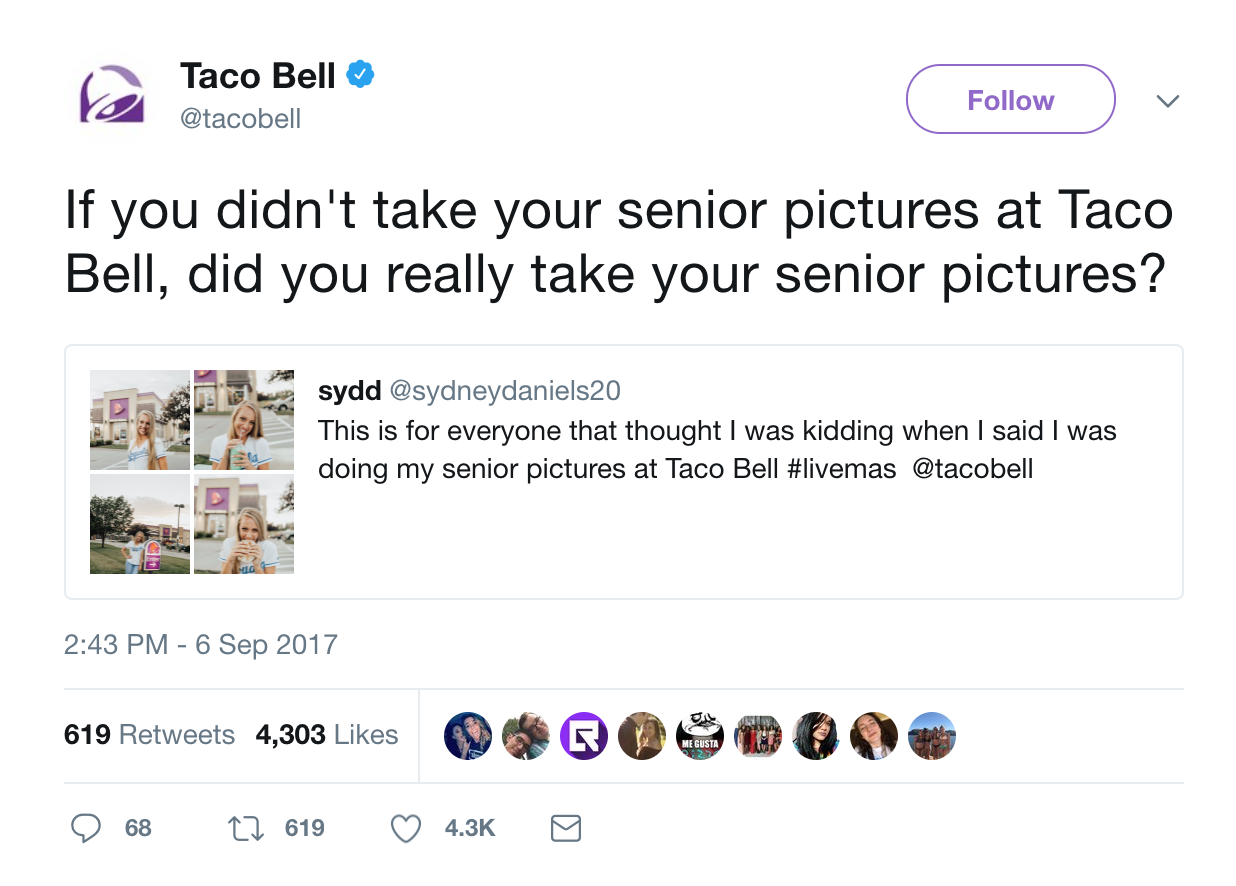
Taking senior portraits at Taco Bell has been a trend this year, and the brand took notice.

Chipotle (@ChipotleTweets)
Promoting their online ordering capabilities while disrupting everyone’s Tinder game.

Totino’s Pizza Rolls (@totinos)
Starting with the name of the account (Pete Zaroll) and the anthropomorphic pizza roll that personifies the account, this General Mills brand really brings the sass, especially when it comes to brand recognition.

Hamburger Helper (@helper)
Another General Mill’s brand, Hamburger Helper’s Twitter account has been in the news lately due to its quick-witted responses like this one:

DiGiorno Pizza (@DiGiornoPizza)
With a tagline like “It’s not delivery. It’s DiGiorno”, would you expect anything less than sassy tweets?

Old Spice (@OldSpice)
Never one to shy away from unconventional marketing and commercials, Old Spice continues that trend with their Twitter feed.

Innocent Drinks (@innocent)
This healthy smoothie/juice company based out of the UK has a Twitter feed filled with gems like this one below. What more could you ask for from a brand’s social media?

Moosejaw Mountaineering (@MoosejawMadness)
Self-described as “the most fun outdoor retailer on the planet”, Moosejaw’s Twitter is filled with funny quips like this one:

Have some more examples? Share them in the comments section below.

 Like this post? Read more at http://steverenner.com/blog-2/

Friday, September 29, 2017

Marketing Trend: Personalized Marketing


Consumers are not strangers to personalized content. People tend to love when they receive offers and content that really fit them and their needs. Think back to email marketing. As a consumer, you may receive emails that seem to know everything about what you are looking for from any number of stores. This is a big example of how personalized marketing can work, but there are also social media ads, banner ads, video ads and more, which can all be personalized to the consumer, either through data collection or extensive targeting.
The key to creating great personalization is having a strategy to create data-driven content. With the content you build using the data you have, your marketing options expand innumerably, and include personalized content.
Defining personalized marketing
Beyond email, personalized marketing may be something you are not familiar with as a consumer, but you will realize that you have been seeing it every day.
The Content Marketing Institute defines the concept of personalized content by saying the following: “content personalization is a strategy that exploits visitor or prospect data to deliver relevant content based on the interests and preferences of the target audience.” You can read more about the approach to content personalization here.
Want to learn more? These companies are doing personalized marketing right!
Amazon
Online retail giant Amazon’s product curation and product recommendations are not new features but are definitely some of the biggest examples of personalized marketing around right now. Each section on your Amazon homepage should harken back to not only your purchase history but also your browsing history and streaming history on Amazon Video.
Spotify
Recommendations for music, compiled playlists and the “Discover Weekly” feature are all built on a Spotify user’s “taste profile”. When you are listening to music, data is taken from each listening session to create stations that fit in with that profile.
Coca-Cola
As discussed in an earlier post about user-generated content, Coca Cola’s “Share a Coke” campaign has remained a staple for the brand since it’s 2011 beginnings, and one reason why is because the personalization factor of finding your own name (especially with the correct spelling or if you have an unusual name) keeps consumers purchasing and engaging with the brand as they find their names.
Facebook
Facebook is already a personalized experience just based on the nature of how it is used, but the addition of “Friendship History Videos” and other personalized options for photos as well as the obvious page, event and friend suggestions make Facebook not only a great platform for individual personalization but also great for marketers looking to target a very specific audience.
Netflix
Netflix is an essential part of many households today, and their rating system is a great way to sort through the amount of content that is available to stream. When you see a show or movie on Netflix you’ll see a rating amount out of five stars. Contrary to normal reviews and ratings, the stars appear based on how Netflix’s algorithm believes you will rate the content based on your past activity.
Personalized content and marketing are a great way to reach your audience even further and perhaps you’ve even seen some other great examples. Share your experiences with personalized marketing in the comments section.
 Like this post? Read more at http://steverenner.com/blog-2/

Wednesday, September 27, 2017

Marketing Trend: Data Driven Content


Looking to make your marketing efforts a little more streamlined? Or just trying to create content that is easy to scale, right for your audience and optimized for search purposes? Data-driven content is the way to go. The biggest hurdle for most marketers is leaving the creative brain behind and getting into a quantitative mindset that allows you to look at your metrics and analyze how to improve those numbers and statistics.
It may sound scary, but using data can really improve your content, SEO and more. Try these tips and tricks from JBH: The Content Agency to get started!

If you still aren’t convinced that data is changing the way marketers think and execute their strategies, take a look at these examples that prove that data-driven marketing and content can work in any industry.
Fitness Tracking: Jawbone
Because fitness tracker Jawbone’s purpose is to collect data for consumer use, it makes sense that their marketing efforts are also highly data-driven. By collecting the data from their customers, the content that is produced is much more relevant to the lifestyles of the entire user base.
Music: Spotify
Spotify users see curated playlists and song suggestions based on their listening history, and via this post from 2013, it’s clear to see that Spotify doesn’t take their analytics lightly. Spotify also has a “Found Them First” feature, that lets you know if you were an early listener of emerging artists that are now big.
Home Search: TruliaZillow
Zillow and Trulia are two giants when it comes to online house hunting, but also when it comes to using data to improve customer experience. From amassing crime data to pricing and neighborhood demographics, the data compiled on these sites and individually compiled from users’ browsing sessions can help homebuyers find the perfect place.
Ridesharing: Uber
Ridesharing app Uber does the typical promotional posts and company updates but also uses the data they compile to create great human interest pieces, like this article. The data Uber uses to create content used for both societal and human nature research.
Data drives the world. How will you use it to create better content?  

 Like this post? Read more at http://steverenner.com/blog-2/