Showing posts with label delivery. Show all posts

Tuesday, October 24, 2017

11 Herbs & Spices: Brands That Embrace Their Personalities on Twitter


Earlier this week, Twitter user Edge (@edgette22) noticed something funny about KFC’s Twitter page that made headlines for the brand.


The quiet execution of this comical marketing strategy isn’t the first time that a brand has used Twitter to subvert traditional marketing efforts for a more playful strategy. Think back to Wendy’s always sassy Twitter responses, like this one:

Fast food companies aren’t the only brands establishing themselves as Twitter masters, check out these examples of brands showing off their personality on social media!
Netflix (@netflix)
The streaming giant knows what it’s target audience is thinking.

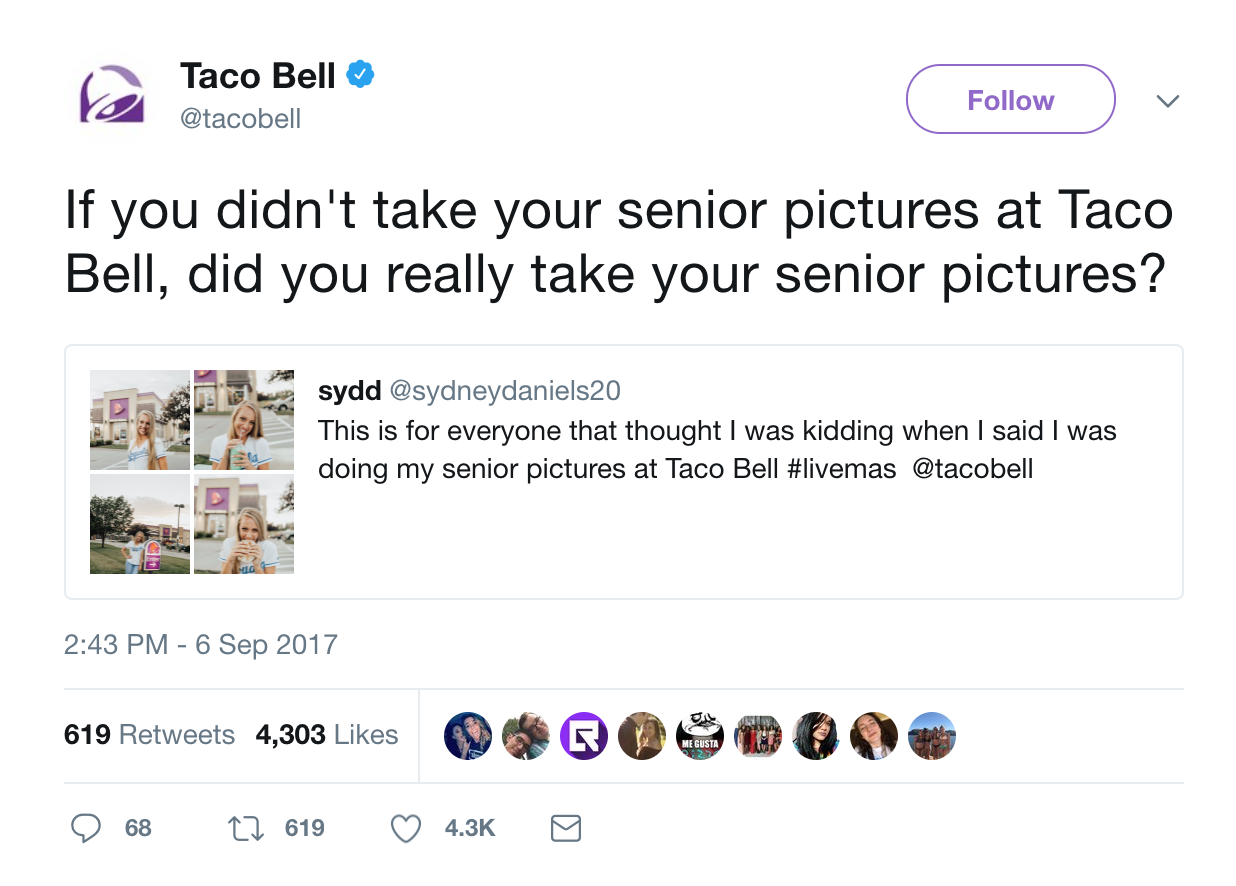
Taco Bell (@tacobell)
Taking senior portraits at Taco Bell has been a trend this year, and the brand took notice.

Chipotle (@ChipotleTweets)
Promoting their online ordering capabilities while disrupting everyone’s Tinder game.

Totino’s Pizza Rolls (@totinos)
Starting with the name of the account (Pete Zaroll) and the anthropomorphic pizza roll that personifies the account, this General Mills brand really brings the sass, especially when it comes to brand recognition.

Hamburger Helper (@helper)
Another General Mill’s brand, Hamburger Helper’s Twitter account has been in the news lately due to its quick-witted responses like this one:

DiGiorno Pizza (@DiGiornoPizza)
With a tagline like “It’s not delivery. It’s DiGiorno”, would you expect anything less than sassy tweets?

Old Spice (@OldSpice)
Never one to shy away from unconventional marketing and commercials, Old Spice continues that trend with their Twitter feed.

Innocent Drinks (@innocent)
This healthy smoothie/juice company based out of the UK has a Twitter feed filled with gems like this one below. What more could you ask for from a brand’s social media?

Moosejaw Mountaineering (@MoosejawMadness)
Self-described as “the most fun outdoor retailer on the planet”, Moosejaw’s Twitter is filled with funny quips like this one:

Have some more examples? Share them in the comments section below.

 Like this post? Read more at http://steverenner.com/blog-2/

Wednesday, July 12, 2017

Why Email Marketing Shouldn’t Be Forgotten


Since the beginning of the internet, email has been one of the top ways we communicate. Regardless of the inception of chat apps, texting, and social media, email usage consistently grows each year. Despite these statistics, email marketing isn’t the main focus of many businesses, which is a shame for many reasons. With email marketing you can grow your business easily. Not convinced? Check out these reasons why email marketing should be a part of your marketing and sales strategies.
Mobile
Email can be accessed in a number of ways, and with at least half of US cellphone users accessing their email on their phones along with the ability for email to be accessed on tablets and other mobile devices, email can reach customers on a much larger scale that incurs less cost than SMS marketing.
Coupons and Bargain Hunters
Sending special offers and coupons to customers through email can cause a hesitant buyer to go through with a purchase. Driving engagement with customers is one of the most effective ways that email drives sales. Free shipping, and “buy one, get one” offers are shown to be the most attractive to customers, and with these offers you can increase conversion even within time constraints.
Versatility
Because email marketing is such a customizable marketing tool, it is extremely easy to not only use it for multiple purposes but also to combine it with the rest of your marketing tactics. Creating an integrated marketing strategy with email is one of the easiest ways to maintain the strength of your marketing efforts.
Investment
A recent study found that 85% of US retailers consider email marketing one of the most effective ways to reach customers. With the ability to reach gigantic numbers of customers for a very low price, matched with the effectiveness of this tactic, it’s no wonder that businesses feel that email marketing is worth so much. If doing email blitzes on your own sounds daunting, there are many tools that you can use to develop a highly effective email campaign. These are some of the top resources on the market.
  1. MailChimp
  2. Constant Contact
  3. HubSpot
How have you used email marketing to grow your business? Do you have tools to make it easier? Let me know in comments!
  Like this post? Read more at http://steverenner.com/blog-2/

Monday, November 14, 2016

Google’s Tango Goes Beyond Augmented Reality


Google is well-known for working on highly exploratory products and services. From internet-carrying balloons to cars that drive themselves, and everything in between. One such innovation is Tango, developed by a team led by computer scientist Johnny Lee, a core contributor to Microsoft‘s Kinect, which is part of the same ATAP division that’s currently working on bringing us the first truly modular smartphone.
With the recent announcement from Lenovo that its first Tango-equipped phone is finally on the market, you’re probably curious as to exactly what it is.
To explain Tango in its most basic form: it’s giving devices the ability to see and understand their surroundings in a similar way to how we do. That means building a custom set of sensors and a processor that can connect the various sources of information, and understand it all.
There are three main parts to the Tango technology. First is the motion tracking technology. Using a motion tracking camera, 3D depth sensor, accelerometer, barometer, gyroscope and GPS, a Project Tango-compatible device can tell where it is, and how it’s moving within a specific space or area and which way it’s pointing.
When combined with the second and third features, depth perception and area learning, it can understand the space you’re moving with great accuracy. So if you’re holding it while walking through a narrow corridor and turn a corner, it remembers where you’ve come from and tracks where you’re going. It can even tell where the walls are, and how close you are to specific objects.
Perhaps more impressive within the depth perception is that it can tell whether an object is small and close, or far away and large. It calculates both distance between you and the object, the object’s size, and where it sits in relation to other items in the area
Together, these generate data about the device in “six degrees of freedom” (3 axes of orientation plus 3 axes of motion) and detailed three-dimensional information about the environment.
How To Use Tango
There are a couple of key uses for this kind of technology that Google has listed so far. For the average consumer, augmented realityis going to be one of the biggest draws for this technology. Because its sensors are so advanced, it can use the cameras to detect the surroundings, and then place virtual items in the scene in relation to the real life physical objects. So, you could see, virtually, how a desk or coffee table in a room to see how it would look, or more interactive gamified items.
There are a few games already developed for Project Tango, one of which is called Bullseye’s Playground which essentially builds an entirely virtual 3D world modelled on a building’s physical layout. Users can then interact with characters or throw snowballs and find various surprises on the way. Google partnered with Target in the States to offer an in-store experience to its walk-in customers using this app.
Project Tango will also let users measure objects accurately. You could measure a table, as an example, using augmented reality to draw a joining line between one end and the other. And, because of its motion tracking and area learning technology, you don’t have to hold the device completely still. It can recognize and measure an object regardless of how far away it is, or even if you move during measuring.
What’s more, because it can detect surfaces and knows and measure angles etc. it knows how, and what angle, to place the virtual objects. As a basic example, it knows how to orientate a virtual object to lie on a horizontal surface, like the floor, and it can place items on a vertical surface, like a wall or a chair leg. You can also move your device any which way because it remembers where those surfaces were and where you placed the virtual items.
Tango can also be used to accurately map indoor locations, potentially expanding Google Maps’ knowledge to reach inside buildings. So if you’re in a particularly huge shopping centre and it’s been mapped using Google’s Tango, you can easily find your way using your smartphone.
From a business and enterprise standpoint, Tango could be incredibly useful for estate agents, building surveyors, architects or interior designers who want a more visual way to measure buildings.
Supported Devices
As of right now, there are two devices available to buy with Tango support, and that’s the tablet development kit and the Lenovo Phab2 Pro smartphone. The tablet isn’t the most impressive device spec-wise, but it’s been made primarily so that developers can build apps and programs that make the most of the project’s capabilities.
With the Phab 2 Pro, which is now selling for $499, Lenovo and Google are trying to prove that AR can and should become an integral component of modern smartphones. Lee thinks of Tango’s technology much like GPS, which transformed the utility of mobile phones and, years later, helped give birth to services like Uber. If augmented reality is equally transformative in letting our devices understand physical spaces and “see” the world, it could help reshape entire industries, from gaming to retail to real estate.
Until there’s more devices out there with Tango tech, and that’s not happening until next year, at least, this all feels very much like an experimental test phase for AR. But developers don’t seem too discouraged. That’s both because Pokémon Go proved there’s an appetite for these type of mobile experiences, and Google is convinced it’s only a matter of time before every phone makes the jump to 3D mapping.
“This is something that is not going to go away,” says Legacy Games CEO Ariella Lehrer, whose company is making a kid-friendly zombie game called Crayola Color Blaster. “This ability to understand space is coming, and I think the market is going to be very large.”

Thursday, November 10, 2016

How the Internet of Things Affects Responsive Design


While design can be hard to quantify as an investment, responsive web design has literally paid off for some companies. For example, when Walmart Canada implemented a responsive web design to their website, they increased conversions by 20% and mobile orders by a whopping 98%.
Similarly, according to Mobile Marketer, Kia uses their responsive websites to communicate with consumers on mobile and tablet devices through their content marketing. These responsive websites also serve as the foundation of in-dealership experiences. Kia’s national manager for digital and CRM David Schoonover touches on an interesting point about how content must also be designed to be responsive – because users on their mobile phones will likely be reading for shorter amounts of time than desktop or tablet users, content must also be shortened in order for responsive web design to be at its most effective.
In addition to desktop, mobile, and tablet, there are two other aspects to responsive web design: TV and the Internet of Things. Connected TV is the technical term for any television connected to the internet. TVs are unusual to design for because of the differences in user postures, input capabilities, display properties, and navigation styles (which are practically opposite to computers or phones). Users typically lean back when they’re watching the TV and use a remote control to move around the user interface. The direct antithesis of mobile devices, the image is high resolution and extremely far away on connected TVs. (For more information, see web interfaces master Bill Scott’s Designing for Mice and Men.)
Media companies have already conceived of new ways to connect with consumers through TV. For example, remember how Disney used to send free VHS or DVDs to anyone interested in Disneyland? Disney lets users browse through vacation offerings through its new TV app. Retailer Marks & Spencer recently launched a lifestyle app for TV. Brands, much like networks, don’t have to create their own content. They can easily be curators for programming.
Connected TV is on the rise and will be extremely popular in the future. Designing for it requires large fonts and large images (because the user is so far away); it also means you should keep in mind that the user will be navigating with a remote control. However, it’s still the smaller aspect of an even larger trend: the Internet of Things.
“The Internet of Things is the network of physical objects that contain embedded technology to communicate and sense or interact with their internal states or the external environment.” GigaOM predicts that there will be 24 billion devices connected to the Internet of Things by 2020.
The most tangible example in today’s world is wearable technology. Technology is moving towards broader contextual awareness made possible by more sensors in devices (such as the iPhone 5S’s M7 motion co-processor). The future includes technology like Google’s Project Tango, a device that can create a 3D image of the environment it is in. This opens up doors for more situational contexts, which means more tailored content and engagement. For example, car companies can know when a user sits in a car and display relevant image to connect through their branded service.
Closing Thoughts
As your customers all start to use a wider variety of devices and move through these various channels, they’ll stop engaging with you if you don’t move with them. This is why responsive design is crucial for brands and companies connecting with prospective and current customers. As the pace of technology increases, responsive design will be one of the prevalent solutions that many media companies and brands will find essential to connecting with their audiences.

Thursday, November 3, 2016

How to Increase Your Facebook Ad’s Conversion Rate


Have you ever a created a landing page for your Facebook ads or promoted social media posts to capture leads, drive resource downloads, or get sign-ups for your service? If so, you’d probably like to improve the conversion rates of those landing pages?
The primary goal of any landing page is to collect valuable information that allows you to market to, and communicate with, potential leads. That said, after someone clicks on your Facebook ad (or promoted tweet), the copy and design of the landing page you direct them to are instrumental in the process of collecting leads. In this article, you’ll learn five key copy and design elements for a high-converting landing page.
1. Goal-Driven Copy Length
From your Facebook ad to your landing page, you have less than 10 seconds to grab their attention. So, the first element you’ll need to decide is the length of your copy on your landing page.
When a user is directed to your landing page from your Facebook ad or tweet, you have less than 10 seconds to grab your visitor’s attention and get them to convert. “Convert” could mean a purchase of your product/service, a download of your resource, or to register for your webinar, or to make an appointment, etc.
Shorter copy is typically best when you need to meet an immediate goal. For example, if you want to capture email addresses so you can email subscribers access to an exclusive, limited time only sale, or you want to get sign ups for a free webinar you’re having soon or downloads of an eBook you created, you’ll want to keep your copy short and sweet. The idea is that when people arrive at your landing page, they’ll know exactly what action you want them to take.
Landing pages with more detailed, scrollable copy are best reserved for times you have long-terms goals. Let’s say you want to create awareness for a new product or to educate your audience about a problem or a solution your brand provides. In these cases, long-copy landing pages can help your brand establish trust and credibility with those who click on your ad. 
Landing Page for Facebook Ads
Short-copy landing pages are best used when the purpose of your Facebook ad is to promote resources, newsletters and online events.
Long Form Landing Page
Long-copy landing pages are best used when the purpose of your Facebook ad is to educate your audience and/or create awareness for a solution your brand provides. But, when it comes to longer landing pages, don’t expect to see too many hard conversions immediately. When you’re focusing on a long-term goal, your conversions often come in later. Instead, look at time on page as a success metric. If people are arriving at your Facebook ads’ landing page and not immediately leaving, this is a good sign your landing page is performing well.
2) Limited Form Fields on Landing Page
Keep your form fields to a minimum for a higher conversion rate. The amount of data you want to collect from your ads’ landing page visitors can affect your conversion rate. Ask for too much information and you could turn people away. Especially if your incentive, i.e., what you’re giving away in return, does not feel worthy of the information you’re asking your visitors to share.
You should also keep your landing page’s form fields to a minimum. Your conversion rate goes down as your number of entry fields required increases, according to an infographic published by QuickSprout. When a form has only three fields, its conversion rate is 25 percent. Double the number of form fields and the conversion rate drops to 15 percent.
3) Key Visuals
Visuals deliver emotional cues to your landing page visitors, without the additional copy. The use of visuals on your ads and promoted posts’ landing pages can help quickly communicate messages more effectively than text-only landing pages. Here are three reasons this may be:
  • Our brains process images and their meanings more quickly than they do plain text. This makes sense, as 50 percent of the brain is involved in visual processing and 65 percent of people are visual learners.
  • Visual elements allow you to design a landing page that flows nicely. People have a limited time to spend on your landing page, and they are all easily distracted. Just look at how many tabs are open on your smartphone or desktop right now. All of those pages competing for attention. To help get the point across quickly, use graphics and images to break up the page to make its content easily digestible. The last thing you want is for your visitors to be faced with unappealing, dense blocks of texts, which lead to high bounce rates and low conversions.
  • Visuals have the power to deliver emotional cues and messages to your landing page visitors, without the use of additional copy. For example, if you a have bold red call to action button, this sends a strong signal to visitors that they should take action quickly. Whereas, if your key visuals are primarily blue, the subconscious message is friendlier, more soothing.
People respond positively to well-designed landing pages. Use images and graphics wisely to make sure your landing page is visually appealing. This should reduce your bounce rate, improve visitor retention and help increase conversions.
4) Responsive, i.e., “Mobile-ready,” Design
Consider Facebook’s mobile users (40%) when you design your Facebook ads’ landing page. Every quarter, Facebook’s mobile usage increases. What’s more, of Facebook’s 1.59 billion monthly active users (up 14 percent year-over-year), 1.44 billion are monthly mobile users. Simple mobile usage all around is higher, so it’s important that you design your landing pages with mobile in mind.
To create mobile-ready landing pages for your ads and promoted posts, you can learn HTML and CSS to create your own responsive web pages. Or, you can use a landing page builder tool like ShortStack.com. This will allow you to design landing pages, from templates or scratch, which are automatically optimized for all mobile devices. No fancy coding skills are required.
Remember, how your Facebook ads’ landing page looks and functions on desktop is equally as important as how it looks and functions on a mobile device. Be sure to test your landing page on multiple platforms.
5) A Single Call-to-Action
It’s easier to get a person to do one thing, versus asking them to do two or three things. If you include more than one call-to-action on your promoted posts’ or Facebook ads’ landing page, you risk confusing your visitors. To stay clear of this potential “danger zone”, eliminate all clickable items on your landing page that might distract visitors from accomplishing the primary task.
Don’t include multiple social icons, unnecessary links and tabs, drop-down menus, etc., because having too many “features” on a landing page will only confuse your visitors. The last thing you want to do is distract your visitors and give them reasons to bounce back to Facebook, without visiting the rest of your site or making a purchase.
You will have better luck getting a person to do one thing, versus asking them to do two or three things. Stick to one goal, or action item, per landing page you build.
Conclusion
This list is just the tip of the iceberg. There are many other things to consider when creating high-converting Facebook ads’ landing pages. These five tips should, however, get you started off on the right foot.
What do you do to help maximize the conversions of your promoted posts’ and Facebook ads’ landing pages? Do you focus more on perfecting your landing page’s copy or design?

Like this post? Read more at http://steverenner.com/blog-2/

Wednesday, November 2, 2016

The Nightmare Machine: A Spooky Look at Artificial Intelligence


One of the biological side effects of being a human is the will to live. Luckily for us, one of the ways in which our brain gives the heads up to inform us of potentially dangerous situations is by invoking that little old survival instinct called “fear”.
Have you ever been stuck sitting next to someone in a cinema, completely unfazed by a horror movie, while you diverted your attention to the closest escape door? Everyone gets spooked by out by different stimuli, whether rational—Trump/Pence, the NRA, embezzlement, or irrational—clowns, killer tomatoes, blobs.
Since we know that stimuli can evoke varying psychological responses, one group of researchers from the MIT Media lab, set out to find what unites us in our phobia and terrifies us on a universal scale. And so, they created a horrifying algorithm to generate scary imagery, designed to spook the living daylights out of us mere civilians.
Welcome to the Nightmare Machine:
A monster creation just in time for Halloween, which transforms an idyllic scene, say, an Ikea catalogue or the Taj Mahal, into a slaughterhouse or inferno, using cutting-edge Artificial Intelligence.
The spooky formula is powered by “deep learning algorithms”, and a secret ingredient claimed to be “evil spirits!” The team used two deep learning algorithms: one for extracting artistic styles from one image to apply it to another, and a second algorithm that generates “imagined” faces from trained data.
So far, the team has collected over 200,000 individual evaluations of computer-generated images, using a website form that presents a spooky image and asks the user to rate its scariness factor. The algorithm grew hungrier and hungrier for more user data, until it was able to think and feel on its own.
Starting little by little, experimenting with what they call the “nightmarifying” process, they used deep learning algorithms to learn first how haunted houses, then ghost towns, and more recently toxic cities look. Then, they applied the learned style to famous landmarks. It’s surprising how well the algorithm can extract the element from the “scary” templates and plant it into the landmarks.
The group’s primary goal is to understand the barriers between human and machine co-operation; psychological perceptions of what makes people tick and what make computers tick are an important barrier for such cooperation to emerge.
If you’re trying to decide what’s more terrifying, the images, or the idea that an intelligent machine is capable of generating them, the team assures you that they are interested in testing this experimentally to find out, so keep your eyes peeled for more updates from the Nightmare Machine.
Like this post? Read more at http://steverenner.com/blog-2/

Wednesday, October 12, 2016

Make Email Essential to Your Content Marketing Strategy


If you go to any internet marketing event, you’ll be sure to hear one thing over and over again: content marketing. This hot new art and science of being an effective brand publisher is more than just a trend; it’s the atomic bomb of all marketing.
As content marketing rises in importance, email marketing is also becoming a tried and true channel for reaching people where they gather every day: their inbox. Why? Because people are constantly checking their email. According to the Direct Marketing Association, email marketing yields an estimated 4,300% ROI.
While these seemingly separate practice areas of content marketing and email marketing are marching forward in parallel, they’re actually on a collision course.
The intersection of content marketing and email marketing is delivering branded editorial content via email. Here’s the big opportunity: Use email to re-engage users with personalized content selected based on their history and demonstrated interests across other digital channels.
So, why does content marketing deserve special treatment? Branded editorial has some very distinct challenges and opportunities that set it apart from typical promos and offers:
  • Content is has a long shelf life. The best brand content never expires. This is because people who are interested in a topic, say Garden Homes, are likely to be interested in that subject for an extended period of time.
  • Content has a ton of meta data. Editorial content has many words and a variety of formats, so there’s much more meta data that can be used to select it.
  • Brands have a lot of it. The best content marketers have hundreds of pieces of content. A content personalization solution needs to be able to analyze, classify, reformat and target large volumes of content.
The same thinking applies across categories. For example, consider Delta Faucet, who through its Inspired Living hub offers a range of how-tos, design ideas and trend articles. They knew that their content portfolio covered a wide range of interests that didn’t fit neatly into a one-size-fits-all or segment based approach. So, by individually personalizing their overall content experience, Delta Faucet has been able to drive a nearly 30% lift in engagement.
The best content marketers are now thinking about email and content as connective tissue for the broader digital saga. Leveraging data across channels to develop a predictive approach to content selection—in email as well as other channels—is proving to be an essential technique for driving repeat engagement and ultimately building long-lived relationships with customers.
But, how does this method of cross-channel content sequencing actually impact your email marketing efforts though? One major, US grocery brand recently added such personalized content to their email newsletter programs—leveraging past topic interests in other channels—and saw up to a 180% lift in the email click-to-open rate. Importantly, they reduced the time needed to manually curate editorial sections of email by 99%.
How can your brand start moving the needle on this front? Here are three steps the best brands are taking to unify their email and content strategies in the most optimal ways:
  • Audit your content. It sounds basic, but it’s absolutely essential to have a complete and comprehensive understanding of your content portfolio. Key questions: How many pieces are there? What formats and lengths are represented? What types of topics and subtopics are reflected and how often are you publishing?
  • Audit your email. In other words, know what you’re sending. Key questions: What is your brand’s total email footprint? For any given type of subscriber what does the totality of volume and types of email look like? Which email products are best poised for including or featuring personalized content selections and which ones should potentially be exempt?
  • Define success. You want to make your content and email marketing strategies work together better and deliver a more personalized experience. What does actual success look like and what are the key metrics that tell you you’re doing well?
Bringing the two worlds of content marketing and email marketing together to support each other can be highly beneficial and it can help your brand capitalize on two of the most important practice areas of modern marketing. By taking a data-driven approach and pursuing a well-defined marketing technology roadmap, today’s modern marketers can effectively serve their customers better than ever.

Tuesday, September 27, 2016

Amazon Drones: The Future of Delivery


For the past five years Amazon has been diligently researching and developing it’s ambitious Prime Air plan. The plan, a 30-minute delivery service using drone technology may sound far fetched, but the reality may be a lot closer than you think. One stumbling block for the plan is a Federal Aviation Administration (FAA) stipulation that requires drones to be in the line of sight of the operator at all times. For this reason, Amazon is putting pressure on the FAA for a nationwide drone-based air traffic control system, which would allow autonomous drones using built-in technology and GPS to safely fly a pre-programmed route.
“The hardest challenge in making this happen is going to be demonstrating this to the standards of the FAA (Federal Aviation Administration) that this is a safe thing to do,” Amazon CEO Jeff Bezos explained to Charlie Rose in a 60-minute interview about the future of Prime Air.
A video, released back in 2013 (now with over 16 million views) revealed exactly how the delivery method would work. The process begins at the fulfillment center where a small yellow box automatically attaches to a Prime Air octocopter. It then flies off to the specified location. It has yet to be determined whether the drone will fly using GPS technology or guided by a controller.

Enter the CAA. Earlier this year Amazon partnered with the U.K. Civil Aviation Authority to explore beyond-the-line-of-sight operations in rural and suburban areas.
“The UK is a leader in enabling drone innovation — we’ve been investing in Prime Air research and development here for quite some time,” said Paul Misener, Amazon’s Vice President of Global Innovation Policy and Communications, in today’s announcement. “This announcement strengthens our partnership with the UK and brings Amazon closer to our goal of using drones to safely deliver parcels in 30 minutes to customers in the UK and elsewhere around the world.” It has also been disclosed that Amazon is testing its drones in the Netherlands and Canada.
Currently, Amazon is testing drones that weigh less than 55 pounds, are battery-powered, are capable of operating beyond the line of sight of 10 miles, can fly under 400 feet and travel at speeds over 50 mph. These devices are programmed to work with sensors and avoidance technology. As of yet, the drones are able to efficiently transport devices up to 4.5 pounds in 30-minutes or less.
Permission to test the delivery service in the U.K. has provided Amazon with a major step forward in what was currently deemed a grand publicity stunt. “We are committed to realise our mission for Prime Air,” said Daniel Buchmueller, the co-founder of Amazon’s drone program. The company continues to work with regulators and policymakers from all over the world in order to make Prime Air a reality to customers in the near future.
Like this post? Read more at http://steverenner.com/blog-2/